

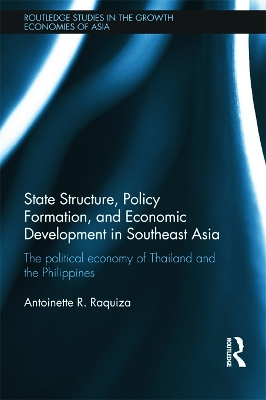
Why do some small, developing countries industrialize and others don’t? What factors account for different economic performance among states that are vulnerable to external shocks, crony capitalism, and political instability? This book argues that the answer lies in the structuring of state power, specifically the way different sets of governing elites – political leaders and economic technocrats – are embedded in political organisations and state institutions, and the way these elites relate to each other in the economic development policy process. Conducting a comparative historical analysis of Thailand and the Philippines, the book argues that the institutional settings of governing elites influence economic outcomes. In Thailand, political power traditionally connects to state institutions in ways that has limited the impact of political turnovers and global downturns - conducive to long-term industrial activities. In contrast, Philippine state power derives from family networks that merge social and political power, suited to fast-moving, short-term commercial interests. In focusing on this political and institutional story, the author analyses the current development dilemmas of countries, weighed down by historical legacies of unstable regimes, dependency, and social conflict, and how they are likely to develop in the future.
| ISBN: | 9780415728348 |
| Publication date: | 7th October 2013 |
| Author: | Antoinette R De La Salle University, Philippines Raquiza |
| Publisher: | Routledge an imprint of Taylor & Francis Ltd |
| Format: | Paperback |
| Pagination: | 204 pages |
| Series: | Routledge Studies in the Growth Economies of Asia |
| Genres: |
Development economics and emerging economies Development studies Political economy |
Why do some small, developing countries industrialize and others don’t? What factors account for different economic performance among states that are vulnerable to external shocks, crony capitalism, and political instability? This book argues that the answer lies in the structuring of state power, specifically the way different sets of governing elites – political leaders and economic technocrats – are embedded in political organisations and state institutions, and the way these elites relate to each other in the economic development policy process. Conducting a comparative historical analysis of Thailand and the Philippines, the book argues that the institutional settings of governing elites influence economic outcomes. In Thailand, political power traditionally connects to state institutions in ways that has limited the impact of political turnovers and global downturns - conducive to long-term industrial activities. In contrast, Philippine state power derives from family networks that merge social and political power, suited to fast-moving, short-term commercial interests. In focusing on this political and institutional story, the author analyses the current development dilemmas of countries, weighed down by historical legacies of unstable regimes, dependency, and social conflict, and how they are likely to develop in the future.
State Structure, Policy Formation, and Economic Development in Southeast Asia features in the following genres: Development economics and emerging economies, Development studies, Political economy
State Structure, Policy Formation, and Economic Development in Southeast Asia is available in Paperback, Hardback
State Structure, Policy Formation, and Economic Development in Southeast Asia was written by Antoinette R De La Salle University, Philippines Raquiza and published by Routledge an imprint of Taylor & Francis Ltd
State Structure, Policy Formation, and Economic Development in Southeast Asia has 204 pages
Yes it is part of Routledge Studies in the Growth Economies of Asia series
£55.79