

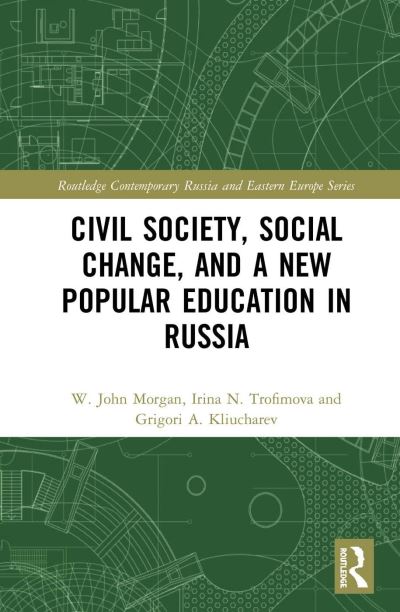
Civil Society, Social Change and a New Popular Education in Russia is a detailed account of contemporary issues that draws upon recent survey research conducted by the Institute of Sociology, Russian Academy of Sciences, as well as from secondary published work in both Russian and English. The book explores how social change and developments in civil society are occurring in Russia and the role played by a new popular education. The right to lifelong learning is guaranteed by the Russian state, as it was by the Soviet Union, where formal education, based on communist ideology, emphasised the needs of the state over those of individuals. In practice a wide range of educational needs, many of which relate to coping with changing economic, social and technological circumstances, are being met by non-governmental providers, including commercial companies, self-help groups, and community and neighbourhood clubs. This book discusses how this new popular education is both an example of developing civil society and stimulates its further development. However, as the book points out, it is also part of a growing educational divide, where motivated, articulate people take advantage of new opportunities, while disadvantaged groups such as the unemployed and the rural poor continue to be excluded.
| ISBN: | 9780415709132 |
| Publication date: | 20th September 2018 |
| Author: | W John Morgan, Grigori Kliucharev |
| Publisher: | Routledge an imprint of Taylor & Francis |
| Format: | Hardback |
| Pagination: | 224 pages |
| Series: | Routledge Contemporary Russia and Eastern Europe Series |
| Genres: |
Non-governmental organizations (NGOs) Sociology Adult education, continuous learning |
Civil Society, Social Change and a New Popular Education in Russia is a detailed account of contemporary issues that draws upon recent survey research conducted by the Institute of Sociology, Russian Academy of Sciences, as well as from secondary published work in both Russian and English. The book explores how social change and developments in civil society are occurring in Russia and the role played by a new popular education. The right to lifelong learning is guaranteed by the Russian state, as it was by the Soviet Union, where formal education, based on communist ideology, emphasised the needs of the state over those of individuals. In practice a wide range of educational needs, many of which relate to coping with changing economic, social and technological circumstances, are being met by non-governmental providers, including commercial companies, self-help groups, and community and neighbourhood clubs. This book discusses how this new popular education is both an example of developing civil society and stimulates its further development. However, as the book points out, it is also part of a growing educational divide, where motivated, articulate people take advantage of new opportunities, while disadvantaged groups such as the unemployed and the rural poor continue to be excluded.
Civil Society, Social Change and the New Popular Education in Russia features in the following genres: Philosophy and theory of education, Regional / International studies, Politics and government
Civil Society, Social Change and the New Popular Education in Russia is available in Hardback
Civil Society, Social Change and the New Popular Education in Russia was written by W John Morgan, Grigori Kliucharev and published by Routledge an imprint of Taylor & Francis
Civil Society, Social Change and the New Popular Education in Russia has 224 pages
Yes it is part of Routledge Contemporary Russia and Eastern Europe Series series
£139.50