

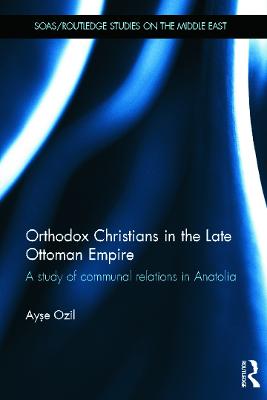
Orthodox Christians, as well as other non-Muslims of the Ottoman Empire, have long been treated as insular and homogenous entities, distinctly different and separate from the rest of the Ottoman world. Despite this view prevailing in mainstream historiography, some scholars have suggested recently that non-Muslim life was not as monolithic and rigid as is often supposed. In an endeavour to understand the ties among Christians within the administrative, social and economic structures of the imperial and Orthodox Christian worlds, Ay?e Ozil engages in a rarely undertaken comparative analysis of Ottoman, Greek and European archival sources. Using the hitherto under-explored region of Hüdavendigar in the heartland of the empire as a case study, she questions commonplace assumptions about the meaning of ethno-religious community within a Middle Eastern imperial framework. Offering a more nuanced investigation of Ottoman Christians by connecting Ottoman and Greek history, which are often treated in isolation from one another, this work sheds new light on communal existence.
| ISBN: | 9780415682633 |
| Publication date: | 12th December 2012 |
| Author: | Ayse Princeton University, USA Ozil |
| Publisher: | Routledge an imprint of Taylor & Francis Ltd |
| Format: | Hardback |
| Pagination: | 208 pages |
| Series: | SOAS/Routledge Studies on the Middle East |
| Genres: |
European history Middle Eastern history Orthodox and Oriental Orthodox Churches History of religion |
Orthodox Christians, as well as other non-Muslims of the Ottoman Empire, have long been treated as insular and homogenous entities, distinctly different and separate from the rest of the Ottoman world. Despite this view prevailing in mainstream historiography, some scholars have suggested recently that non-Muslim life was not as monolithic and rigid as is often supposed. In an endeavour to understand the ties among Christians within the administrative, social and economic structures of the imperial and Orthodox Christian worlds, Ay?e Ozil engages in a rarely undertaken comparative analysis of Ottoman, Greek and European archival sources. Using the hitherto under-explored region of Hüdavendigar in the heartland of the empire as a case study, she questions commonplace assumptions about the meaning of ethno-religious community within a Middle Eastern imperial framework. Offering a more nuanced investigation of Ottoman Christians by connecting Ottoman and Greek history, which are often treated in isolation from one another, this work sheds new light on communal existence.
Orthodox Christians in the Late Ottoman Empire features in the following genres: European history, Middle Eastern history, Orthodox and Oriental Orthodox Churches, History of religion
Orthodox Christians in the Late Ottoman Empire is available in Hardback
Orthodox Christians in the Late Ottoman Empire was written by Ayse Princeton University, USA Ozil and published by Routledge an imprint of Taylor & Francis Ltd
Orthodox Christians in the Late Ottoman Empire has 208 pages
Yes it is part of SOAS/Routledge Studies on the Middle East series
£169.19