

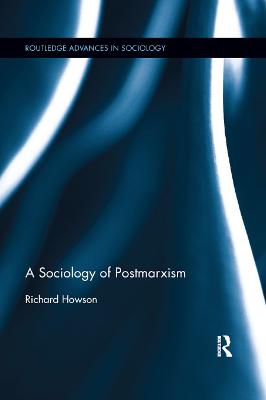
Postmarxism is often depicted as a point of intersection for a set of inter-disciplinary theories that are in themselves complex and dense. Bringing the postmarxist theory of Ernesto Laclau into the field of political sociology through a close reading and analysis of postmarxism and its relationship to ‘the social’, A Sociology of Postmarxism develops key postmarxist arguments in an engaging and sociologically applicable way. Indeed, through a threefold method of analysis, Howson first unpacks the relationship between ‘the social’ and ‘the political’ by analysing key allied theories to show where the points of connection occur. This is then followed by an insightful analysis of the key features of postmarxist theory such as antagonism and the inevitability of social dislocation, the political importance of hegemony; and the empty signifier thesis and equivalence to show how such theory can be applied at a sociological level. Finally, through the use of sociological categories such as masculinities, migration and social capital, the foregoing theoretical analyses are synthesised to show the social nature of postmarxism and particularly in the context of aspiration and co-operation. This enlightening volume will appeal to undergraduate and postgraduate students, as well as postdoctoral researchers who are interested in fields such as Political Sociology, Post Marxist Political Theory and Social Theory.
| ISBN: | 9780367866068 |
| Publication date: | 10th December 2019 |
| Author: | Richard Howson |
| Publisher: | Routledge an imprint of Taylor & Francis Ltd |
| Format: | Paperback |
| Pagination: | 160 pages |
| Series: | Routledge Advances in Sociology |
| Genres: |
Politics and government Political science and theory Political ideologies and movements Sociology Sociology Political science and theory Social theory |
Postmarxism is often depicted as a point of intersection for a set of inter-disciplinary theories that are in themselves complex and dense. Bringing the postmarxist theory of Ernesto Laclau into the field of political sociology through a close reading and analysis of postmarxism and its relationship to ‘the social’, A Sociology of Postmarxism develops key postmarxist arguments in an engaging and sociologically applicable way. Indeed, through a threefold method of analysis, Howson first unpacks the relationship between ‘the social’ and ‘the political’ by analysing key allied theories to show where the points of connection occur. This is then followed by an insightful analysis of the key features of postmarxist theory such as antagonism and the inevitability of social dislocation, the political importance of hegemony; and the empty signifier thesis and equivalence to show how such theory can be applied at a sociological level. Finally, through the use of sociological categories such as masculinities, migration and social capital, the foregoing theoretical analyses are synthesised to show the social nature of postmarxism and particularly in the context of aspiration and co-operation. This enlightening volume will appeal to undergraduate and postgraduate students, as well as postdoctoral researchers who are interested in fields such as Political Sociology, Post Marxist Political Theory and Social Theory.
The Sociology of Postmarxism features in the following genres: Politics and government, Political science and theory, Political ideologies and movements, Sociology, Sociology, Political science and theory, Social theory
The Sociology of Postmarxism is available in Paperback, Hardback
The Sociology of Postmarxism was written by Richard Howson and published by Routledge an imprint of Taylor & Francis Ltd
The Sociology of Postmarxism has 160 pages
Yes it is part of Routledge Advances in Sociology series
£42.29