

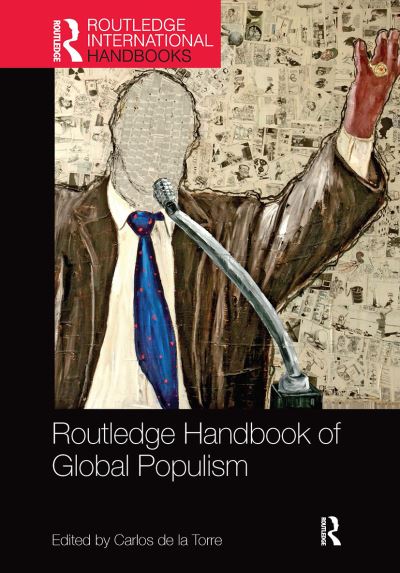
This volume illustrates the diversity of populism globally. When seeking power, populists politicize issues, and point to problems that need to be addressed such as inequalities, the loss of national sovereignty to globalization, or the rule of unresponsive political elites. Yet their solutions tend to be problematic, simplistic, and in most instances, instead of leading to better forms of democracy, their outcomes are authoritarian. Populists use a playbook of concentrating power in the hands of the president, using the legal system instrumentally to punish critics, and attacking the media and civil society. Despite promising to empower the people, populists lead to processes of democratic erosion and even transform malfunctioning democracies into hybrid regimes.
The Routledge Handbook of Global Populism provides instructors, students, and researchers with a thorough and systematic overview of the history and development of populism and analyzes the main debates. It is divided into sections on the theories of populism, on political and social theory and populism, on how populists politicize inequalities and differences, on the media and populism, on its ambiguous relationships with democratization and authoritarianism, and on the distinct regional manifestations of populism. Leading international academics from history, political science, media studies, and sociology map innovative ideas and areas of theoretical and empirical research to understand the phenomenon of global populism.
| ISBN: | 9780367659776 |
| Publication date: | 30th September 2020 |
| Author: | Carlos de la Torre |
| Publisher: | Routledge an imprint of Taylor & Francis |
| Format: | Paperback |
| Pagination: | 484 pages |
| Series: | Routledge International Handbooks |
| Genres: |
Political ideologies and movements Media studies Political structure and processes |
This volume illustrates the diversity of populism globally. When seeking power, populists politicize issues, and point to problems that need to be addressed such as inequalities, the loss of national sovereignty to globalization, or the rule of unresponsive political elites. Yet their solutions tend to be problematic, simplistic, and in most instances, instead of leading to better forms of democracy, their outcomes are authoritarian. Populists use a playbook of concentrating power in the hands of the president, using the legal system instrumentally to punish critics, and attacking the media and civil society. Despite promising to empower the people, populists lead to processes of democratic erosion and even transform malfunctioning democracies into hybrid regimes.
The Routledge Handbook of Global Populism provides instructors, students, and researchers with a thorough and systematic overview of the history and development of populism and analyzes the main debates. It is divided into sections on the theories of populism, on political and social theory and populism, on how populists politicize inequalities and differences, on the media and populism, on its ambiguous relationships with democratization and authoritarianism, and on the distinct regional manifestations of populism. Leading international academics from history, political science, media studies, and sociology map innovative ideas and areas of theoretical and empirical research to understand the phenomenon of global populism.
The Routledge Handbook of Global Populism features in the following genres: Political science and theory, Far-right political ideologies and movements, Political campaigning and advertising, Social and political philosophy, Social theory, International relations
The Routledge Handbook of Global Populism is available in Paperback, Hardback
The Routledge Handbook of Global Populism was written by Carlos de la Torre and published by Routledge an imprint of Taylor & Francis
The Routledge Handbook of Global Populism has 484 pages
Yes it is part of Routledge International Handbooks series
£50.39