

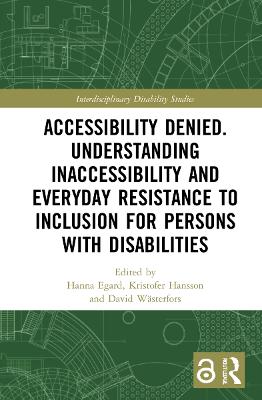
This book explores the societal resistance to accessibility for persons with disabilities, and tries to set an example of how to study exclusion in a time when numerous policies promise inclusion. With 12 chapters organised in three parts, the book takes a comprehensive approach to accessibility, covering transport and communication, knowledge and education, law and organisation. Topics within a wide cross-disciplinary field are covered, including disability studies, social work, sociology, ethnology, social anthropology, and history. The main example is Sweden, with its implementation of the United Nations Convention on the Rights of Persons with Disabilities within the context of the Nordic welfare state. By identifying and discussing persistent social and cultural conditions as well as recurring situations and interactions that nurture resistance to advancing accessibility, despite various strong laws promoting it, the book’s conclusions are widely transferable. It argues for the value of alternating between methods, theoretical perspectives, and datasets to explore how new arenas, resources and technologies cause new accessibility concerns — and possibilities — for persons living with impairments. We need to be able to follow actors closely to uncover how they feel, act, and argue, but also to connect to wider discursive and institutional patterns and systems. This book will be of interest to scholars and students of disability studies, social work, sociology, ethnology, social anthropology, political science, and organisation studies.
| ISBN: | 9780367637286 |
| Publication date: | 10th November 2021 |
| Author: | Hanna Egard |
| Publisher: | Routledge an imprint of Taylor & Francis Ltd |
| Format: | Hardback |
| Pagination: | 218 pages |
| Series: | Interdisciplinary Disability Studies |
| Genres: |
Coping with / advice about physical impairments / disability Disability: social aspects Human geography Sociology Geography |
This book explores the societal resistance to accessibility for persons with disabilities, and tries to set an example of how to study exclusion in a time when numerous policies promise inclusion. With 12 chapters organised in three parts, the book takes a comprehensive approach to accessibility, covering transport and communication, knowledge and education, law and organisation. Topics within a wide cross-disciplinary field are covered, including disability studies, social work, sociology, ethnology, social anthropology, and history. The main example is Sweden, with its implementation of the United Nations Convention on the Rights of Persons with Disabilities within the context of the Nordic welfare state. By identifying and discussing persistent social and cultural conditions as well as recurring situations and interactions that nurture resistance to advancing accessibility, despite various strong laws promoting it, the book’s conclusions are widely transferable. It argues for the value of alternating between methods, theoretical perspectives, and datasets to explore how new arenas, resources and technologies cause new accessibility concerns — and possibilities — for persons living with impairments. We need to be able to follow actors closely to uncover how they feel, act, and argue, but also to connect to wider discursive and institutional patterns and systems. This book will be of interest to scholars and students of disability studies, social work, sociology, ethnology, social anthropology, political science, and organisation studies.
Accessibility Denied. Understanding Inaccessibility and Everyday Resistance to Inclusion for Persons with Disabilities features in the following genres: Coping with / advice about physical impairments / disability, Disability: social aspects, Human geography, Sociology, Geography
Accessibility Denied. Understanding Inaccessibility and Everyday Resistance to Inclusion for Persons with Disabilities is available in Hardback
Accessibility Denied. Understanding Inaccessibility and Everyday Resistance to Inclusion for Persons with Disabilities was written by Hanna Egard and published by Routledge an imprint of Taylor & Francis Ltd
Accessibility Denied. Understanding Inaccessibility and Everyday Resistance to Inclusion for Persons with Disabilities has 218 pages
Yes it is part of Interdisciplinary Disability Studies series
£154.79