

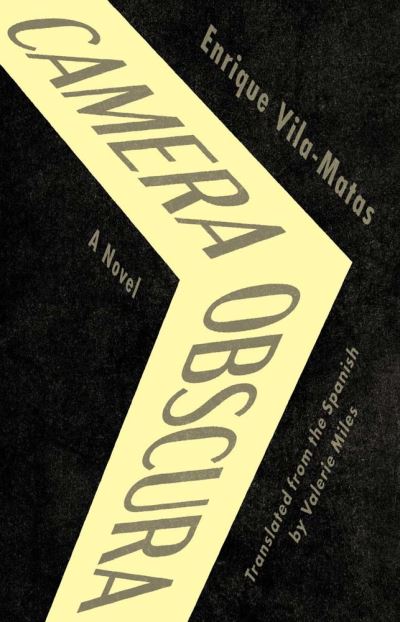
From Spain's most celebrated author, an inventive, quietly radical novel that explores how books illuminate our lives
In Camera Obscura, Enrique Vila-Matas returns with a novel-in-motion that turns the very act of looking into a literary method. Set in Barcelona, the novel follows widower Vidal Escabia as he undertakes a precise, time-bound task. Over the course of seventy-one days, he must construct an "untimely" counter-canon by entering his home library in darkness, reaching for a book at random, and, in the light of his picture window, selecting a single fragment. What begins as the fulfillment of his master's dying wish gradually gathers force, propelling the reader through a journey governed by luck yet shaped by necessity.
The fragments accumulate; so, too, do the stakes. As he moves through Barcelona among androids known as the Denver-7, Escabia is haunted by his estrangement from his only daughter, and by the absence of his beloved wife, lost to the cliffs of Tojinbo. In this unstable landscape, where human intention increasingly intersects with automation and chance, the novel builds a subtle but persistent tension: Is Escabia truly constructing the canon, or is another intelligence at work alongside him, in the dark?
Camera Obscura refracts Vila-Matas's singular vision into a book about how we see, how we read, and how meaning assembles itself in the margins of our experience.
| ISBN: | 9780300290097 |
| Publication date: | 26th January 2027 |
| Author: | Enrique VilaMatas |
| Publisher: | Yale University Press |
| Format: | Paperback |
| Pagination: | 176 pages |
| Series: | The Margellos World Republic of Letters |
| Genres: |
Modern and Contemporary Fiction |
From Spain's most celebrated author, an inventive, quietly radical novel that explores how books illuminate our lives
In Camera Obscura, Enrique Vila-Matas returns with a novel-in-motion that turns the very act of looking into a literary method. Set in Barcelona, the novel follows widower Vidal Escabia as he undertakes a precise, time-bound task. Over the course of seventy-one days, he must construct an "untimely" counter-canon by entering his home library in darkness, reaching for a book at random, and, in the light of his picture window, selecting a single fragment. What begins as the fulfillment of his master's dying wish gradually gathers force, propelling the reader through a journey governed by luck yet shaped by necessity.
The fragments accumulate; so, too, do the stakes. As he moves through Barcelona among androids known as the Denver-7, Escabia is haunted by his estrangement from his only daughter, and by the absence of his beloved wife, lost to the cliffs of Tojinbo. In this unstable landscape, where human intention increasingly intersects with automation and chance, the novel builds a subtle but persistent tension: Is Escabia truly constructing the canon, or is another intelligence at work alongside him, in the dark?
Camera Obscura refracts Vila-Matas's singular vision into a book about how we see, how we read, and how meaning assembles itself in the margins of our experience.
Camera Obscura features in the following genres: Modern and Contemporary Fiction
Camera Obscura is available in Paperback
Camera Obscura was written by Enrique VilaMatas and published by Yale University Press
Camera Obscura has 176 pages
Yes it is part of The Margellos World Republic of Letters series
£18.00