

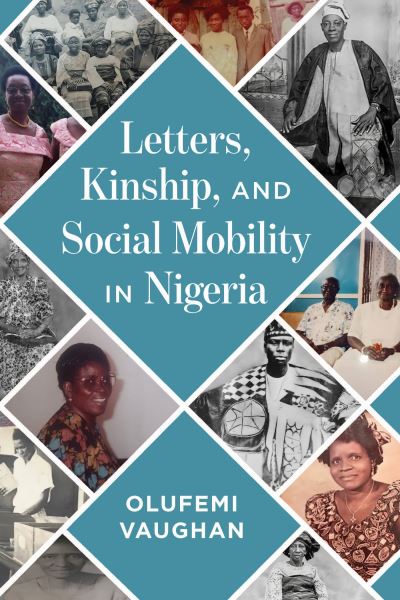
In 2003, Olufemi Vaughan received from his ninety-five-year-old father, Abiodun, a trove of more than three thousand letters written by four generations of his family in Ibadan, Nigeria, between 1926 and 1994. The people who wrote these letters had emerged from the religious, social, and educational institutions established by the Church Missionary Society, the preeminent Anglican mission in the Atlantic Nigerian region following the imposition of British colonial rule. Abiodun, recruited to be a civil servant in the colonial Department of Agriculture, became a leader of a prominent family in Ibadan, the dominant Yordb¦ city in southern Nigeria. Reading deeply in these letters, Vaughan realized he had a unique set of sources to illuminate everyday life. Letter writing was a dominant form of communication for Western-educated elites in colonial Africa, especially in Nigeria. Exposure to the modern world and a growing sense of nationalism were among the factors that led people to begin exchanging letters, particularly in their interactions with British colonial authorities. Vaughan reconstructs dominant storylines, including themes such as kinship, social mobility, Western education, modernity, and elite consolidation in colonial and postcolonial Nigeria. He brings to life a portrait, at once intimate and expansive, of a community during a transformative period in African history.
| ISBN: | 9780299344542 |
| Publication date: | 31st March 2025 |
| Author: | Olufemi Vaughan |
| Publisher: | The University of Wisconsin Press an imprint of University of Wisconsin Press |
| Format: | Paperback |
| Pagination: | 282 pages |
| Series: | Africa and the Diaspora: History, Politics, Culture |
| Genres: |
African history Social classes Sociology |
In 2003, Olufemi Vaughan received from his ninety-five-year-old father, Abiodun, a trove of more than three thousand letters written by four generations of his family in Ibadan, Nigeria, between 1926 and 1994. The people who wrote these letters had emerged from the religious, social, and educational institutions established by the Church Missionary Society, the preeminent Anglican mission in the Atlantic Nigerian region following the imposition of British colonial rule. Abiodun, recruited to be a civil servant in the colonial Department of Agriculture, became a leader of a prominent family in Ibadan, the dominant Yordb¦ city in southern Nigeria. Reading deeply in these letters, Vaughan realized he had a unique set of sources to illuminate everyday life. Letter writing was a dominant form of communication for Western-educated elites in colonial Africa, especially in Nigeria. Exposure to the modern world and a growing sense of nationalism were among the factors that led people to begin exchanging letters, particularly in their interactions with British colonial authorities. Vaughan reconstructs dominant storylines, including themes such as kinship, social mobility, Western education, modernity, and elite consolidation in colonial and postcolonial Nigeria. He brings to life a portrait, at once intimate and expansive, of a community during a transformative period in African history.
Letters, Kinship, and Social Mobility in Nigeria features in the following genres: African history, Social classes, Sociology
Letters, Kinship, and Social Mobility in Nigeria is available in Paperback, Hardback
Letters, Kinship, and Social Mobility in Nigeria was written by Olufemi Vaughan and published by The University of Wisconsin Press an imprint of University of Wisconsin Press
Letters, Kinship, and Social Mobility in Nigeria has 282 pages
Yes it is part of Africa and the Diaspora: History, Politics, Culture series
£20.69