

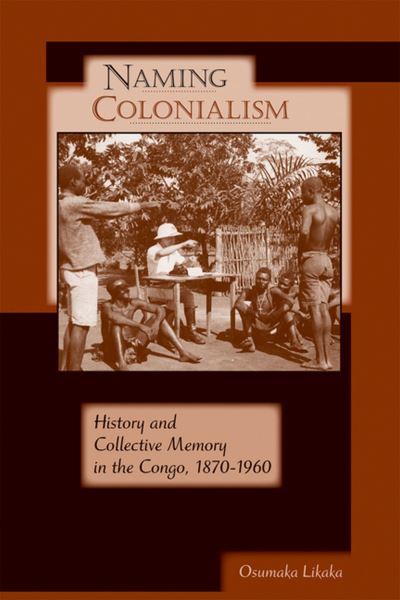
What's in a name? As Osumaka Likaka argues in this illuminating study, the names that Congolese villagers gave to European colonizers reveal much about how Africans experienced and reacted to colonialism. The arrival of explorers, missionaries, administrators, and company agents allowed Africans to observe Westerners' physical appearances, behavior, and cultural practices at close range - often resulting in subtle yet trenchant critiques. By naming Europeans, Africans turned a universal practice into a local mnemonic system, recording and preserving the village's understanding of colonialism in the form of pithy verbal expressions that were easy to remember and transmit across localities, regions, and generations. Methodologically innovative, ""Naming Colonialism"" advances a new approach that shows how a cultural process - the naming of Europeans - can provide a point of entry into economic and social histories. Drawing on archival documents and oral interviews, Likaka encounters and analyzes a welter of coded fragments. The vivid epithets Congolese gave to rubber company agents - 'the home burner', 'Leopard', 'Beat, beat', 'The hippopotamus-hide whip' - clearly conveyed the violence that underpinned colonial extractive economies. Other names were subtler, hinting at derogatory meaning by way of riddles, metaphors, or symbols to which the Europeans were oblivious. Africans thus emerge from this study as autonomous actors whose capacity to observe, categorize, and evaluate reverses our usual optic, providing a critical window on central African colonialism in its local and regional dimensions.
| ISBN: | 9780299233648 |
| Publication date: | 8th December 2009 |
| Author: | Osumaka Likaka |
| Publisher: | The University of Wisconsin Press an imprint of University of Wisconsin Press |
| Format: | Paperback |
| Pagination: | 220 pages |
| Series: | Africa and the Diaspora: History, Politics, Culture |
| Genres: |
Colonialism and imperialism Anthropology |
What's in a name? As Osumaka Likaka argues in this illuminating study, the names that Congolese villagers gave to European colonizers reveal much about how Africans experienced and reacted to colonialism. The arrival of explorers, missionaries, administrators, and company agents allowed Africans to observe Westerners' physical appearances, behavior, and cultural practices at close range - often resulting in subtle yet trenchant critiques. By naming Europeans, Africans turned a universal practice into a local mnemonic system, recording and preserving the village's understanding of colonialism in the form of pithy verbal expressions that were easy to remember and transmit across localities, regions, and generations. Methodologically innovative, ""Naming Colonialism"" advances a new approach that shows how a cultural process - the naming of Europeans - can provide a point of entry into economic and social histories. Drawing on archival documents and oral interviews, Likaka encounters and analyzes a welter of coded fragments. The vivid epithets Congolese gave to rubber company agents - 'the home burner', 'Leopard', 'Beat, beat', 'The hippopotamus-hide whip' - clearly conveyed the violence that underpinned colonial extractive economies. Other names were subtler, hinting at derogatory meaning by way of riddles, metaphors, or symbols to which the Europeans were oblivious. Africans thus emerge from this study as autonomous actors whose capacity to observe, categorize, and evaluate reverses our usual optic, providing a critical window on central African colonialism in its local and regional dimensions.
Naming Colonialism features in the following genres: Colonialism and imperialism, Anthropology
Naming Colonialism is available in Paperback
Naming Colonialism was written by Osumaka Likaka and published by The University of Wisconsin Press an imprint of University of Wisconsin Press
Naming Colonialism has 220 pages
Yes it is part of Africa and the Diaspora: History, Politics, Culture series