

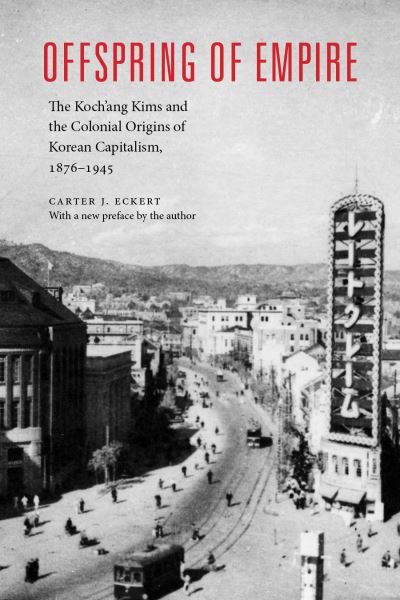
According to conventional interpretations, the Japanese annexation of Korea in 1910 destroyed a budding native capitalist economy on the peninsula and blocked the development of a Korean capitalist class until 1945. In this expansive and provocative study, now available in paperback, Carter J. Eckert challenges the standard view and argues that Japanese imperialism, while politically oppressive, was also the catalyst and cradle of modern Korean industrial development. Ancient ties to China were replaced by new ones to Japan - ties that have continued to shape the South Korean political economy down to the present day.
Eckert explores a wide range of themes, including the roots of capitalist development in Korea, the origins of the modern business elite, the nature of Japanese colonial policy and the Japanese colonial state, the relationship between the colonial government and the Korean economic elite, and the nature of Korean collaboration. He conveys a clear sense of the human complexity, archival richness, and intellectual challenge of the historical period. His documentation is thorough; his arguments are compelling and often strikingly innovative.
| ISBN: | 9780295997742 |
| Publication date: | 3rd August 2015 |
| Author: | Carter J Eckert |
| Publisher: | University of Washington Press |
| Format: | Hardback |
| Pagination: | 416 pages |
| Series: | Korean Studies of the Henry M. Jackson School of International Studies |
| Genres: |
Asian history Capitalism |
According to conventional interpretations, the Japanese annexation of Korea in 1910 destroyed a budding native capitalist economy on the peninsula and blocked the development of a Korean capitalist class until 1945. In this expansive and provocative study, now available in paperback, Carter J. Eckert challenges the standard view and argues that Japanese imperialism, while politically oppressive, was also the catalyst and cradle of modern Korean industrial development. Ancient ties to China were replaced by new ones to Japan - ties that have continued to shape the South Korean political economy down to the present day.
Eckert explores a wide range of themes, including the roots of capitalist development in Korea, the origins of the modern business elite, the nature of Japanese colonial policy and the Japanese colonial state, the relationship between the colonial government and the Korean economic elite, and the nature of Korean collaboration. He conveys a clear sense of the human complexity, archival richness, and intellectual challenge of the historical period. His documentation is thorough; his arguments are compelling and often strikingly innovative.
Offspring of Empire features in the following genres: Asian history, Capitalism
Offspring of Empire is available in Hardback, Paperback, Ebook
Offspring of Empire was written by Carter J Eckert and published by University of Washington Press
Offspring of Empire has 416 pages
Yes it is part of Korean Studies of the Henry M. Jackson School of International Studies series