

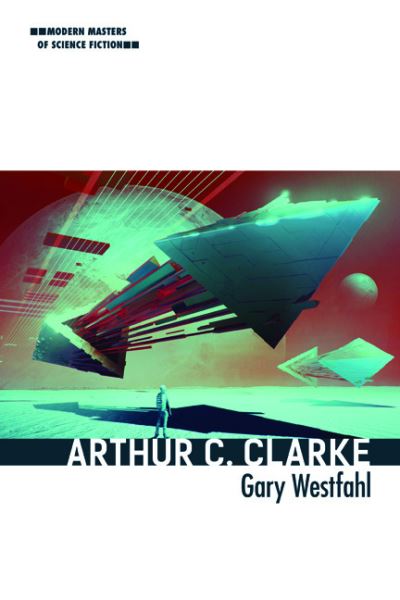
Already renowned for his science fiction and scientific nonfiction, Arthur C. Clarke became the world's most famous science fiction writer after the success of 2001: A Space Odyssey. He then produced novels like Rendezvous with Rama and The Fountains of Paradise that many regard as his finest works.
Gary Westfahl closely examines Clarke's remarkable career, ranging from his forgotten juvenilia to the passages he completed for a final novel, The Last Theorem. As Westfahl explains, Clarke's science fiction offered original perspectives on subjects like new inventions, space travel, humanity's destiny, alien encounters, the undersea world, and religion. While not inclined to mysticism, Clarke necessarily employed mystical language to describe the fantastic achievements of advanced aliens and future humans. Westfahl also contradicts the common perception that Clarke's characters were bland and underdeveloped, arguing that these reticent, solitary individuals, who avoid conventional relationships, represent his most significant prediction of the future, as they embody the increasingly common lifestyle of people in the twenty-first century.
| ISBN: | 9780252041938 |
| Publication date: | 14th June 2018 |
| Author: | Gary Westfahl |
| Publisher: | University of Illinois Press |
| Format: | Hardback |
| Pagination: | 217 pages |
| Series: | Modern Masters of Science Fiction |
| Genres: |
Biography: writers Literary studies: fiction, novelists and prose writers Science Fiction Fantasy |
Already renowned for his science fiction and scientific nonfiction, Arthur C. Clarke became the world's most famous science fiction writer after the success of 2001: A Space Odyssey. He then produced novels like Rendezvous with Rama and The Fountains of Paradise that many regard as his finest works.
Gary Westfahl closely examines Clarke's remarkable career, ranging from his forgotten juvenilia to the passages he completed for a final novel, The Last Theorem. As Westfahl explains, Clarke's science fiction offered original perspectives on subjects like new inventions, space travel, humanity's destiny, alien encounters, the undersea world, and religion. While not inclined to mysticism, Clarke necessarily employed mystical language to describe the fantastic achievements of advanced aliens and future humans. Westfahl also contradicts the common perception that Clarke's characters were bland and underdeveloped, arguing that these reticent, solitary individuals, who avoid conventional relationships, represent his most significant prediction of the future, as they embody the increasingly common lifestyle of people in the twenty-first century.
Arthur C. Clarke features in the following genres: Biography: writers, Literary studies: fiction, novelists and prose writers, Science Fiction, Fantasy
Arthur C. Clarke is available in Paperback, Hardback
Arthur C. Clarke was written by Gary Westfahl and published by University of Illinois Press
Arthur C. Clarke has 217 pages
Yes it is part of Modern Masters of Science Fiction series