

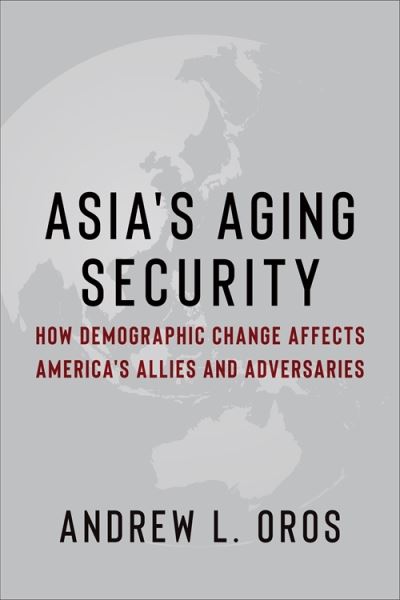
Major demographic transitions are underway in Asia and the Pacific. The populations of China, Japan, Taiwan, South Korea, and Russia are aging and shrinking, while India, the Philippines, Vietnam, and Australia, among others, continue to grow. How will these striking changes affect regional security dynamics and the United States-led alliance structure in the Indo-Pacific?
Andrew L. Oros offers an expert analysis of how rapid aging and population shifts are transforming the military strategies and capabilities of regional powers in Asia. Examining sixteen states, he provides a comparative view of the developing landscape and explores ways to address the consequences. Oros demonstrates that, contrary to what many have claimed, states with shrinking populations will continue to be formidable military powers. He develops a novel theoretical and empirical argument for why rapid aging does not necessarily dampen security competition. Nonetheless, demographic shifts in the coming decades will fundamentally alter the security challenges facing the United States and its allies. Oros considers how technological change and health care advances are mitigating the drawbacks of aging populations as well as how factors such as autonomous defense systems and artificial intelligence present new challenges. Rigorous and timely, Asia's Aging Security makes a forceful case that adjustment to demographic change is a necessity for twenty-first-century foreign policy.
| ISBN: | 9780231205610 |
| Publication date: | 9th September 2025 |
| Author: | Andrew L Oros |
| Publisher: | Columbia University Press |
| Format: | Paperback |
| Pagination: | 320 pages |
| Series: | Contemporary Asia in the World |
| Genres: |
Population and demography International relations Warfare and defence |
Major demographic transitions are underway in Asia and the Pacific. The populations of China, Japan, Taiwan, South Korea, and Russia are aging and shrinking, while India, the Philippines, Vietnam, and Australia, among others, continue to grow. How will these striking changes affect regional security dynamics and the United States-led alliance structure in the Indo-Pacific?
Andrew L. Oros offers an expert analysis of how rapid aging and population shifts are transforming the military strategies and capabilities of regional powers in Asia. Examining sixteen states, he provides a comparative view of the developing landscape and explores ways to address the consequences. Oros demonstrates that, contrary to what many have claimed, states with shrinking populations will continue to be formidable military powers. He develops a novel theoretical and empirical argument for why rapid aging does not necessarily dampen security competition. Nonetheless, demographic shifts in the coming decades will fundamentally alter the security challenges facing the United States and its allies. Oros considers how technological change and health care advances are mitigating the drawbacks of aging populations as well as how factors such as autonomous defense systems and artificial intelligence present new challenges. Rigorous and timely, Asia's Aging Security makes a forceful case that adjustment to demographic change is a necessity for twenty-first-century foreign policy.
Asia's Aging Security features in the following genres: Population and demography, International relations, Warfare and defence
Asia's Aging Security is available in Hardback, Paperback
Asia's Aging Security was written by Andrew L Oros and published by Columbia University Press
Asia's Aging Security has 320 pages
Yes it is part of Contemporary Asia in the World series
£27.00