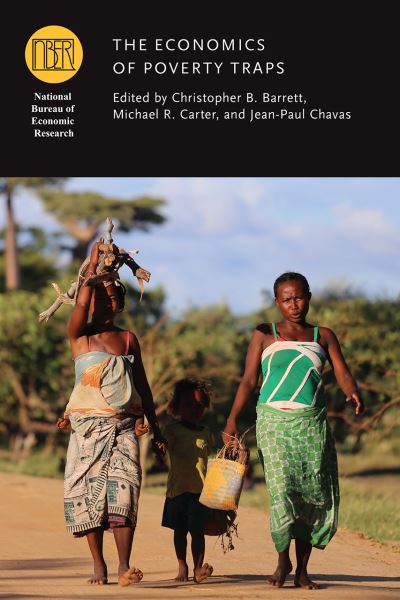
What circumstances or behaviors turn poverty into a cycle that perpetuates across generations? The answer to this question carries especially important implications for the design and evaluation of policies and projects intended to reduce poverty. Yet a major challenge analysts and policymakers face in understanding poverty traps is the sheer number of mechanisms-not just financial, but also environmental, physical, and psychological-that may contribute to the persistence of poverty all over the world.
The research in this volume explores the hypothesis that poverty is self-reinforcing because the equilibrium behaviors of the poor perpetuate low standards of living. Contributions explore the dynamic, complex processes by which households accumulate assets and increase their productivity and earnings potential, as well as the conditions under which some individuals, groups, and economies struggle to escape poverty. Investigating the full range of phenomena that combine to generate poverty traps-gleaned from behavioral, health, and resource economics as well as the sociology, psychology, and environmental literatures-chapters in this volume also present new evidence that highlights both the insights and the limits of a poverty trap lens.
The framework introduced in this volume provides a robust platform for studying well-being dynamics in developing economies.
Buy from our bookstore and 25% of the cover price will be given to a school of your choice to buy more books. *15% of eBooks.
Frequently asked questions
What circumstances or behaviors turn poverty into a cycle that perpetuates across generations? The answer to this question carries especially important implications for the design and evaluation of policies and projects intended to reduce poverty. Yet a major challenge analysts and policymakers face in understanding poverty traps is the sheer number of mechanisms-not just financial, but also environmental, physical, and psychological-that may contribute to the persistence of poverty all over the world.
The research in this volume explores the hypothesis that poverty is self-reinforcing because the equilibrium behaviors of the poor perpetuate low standards of living. Contributions explore the dynamic, complex processes by which households accumulate assets and increase their productivity and earnings potential, as well as the conditions under which some individuals, groups, and economies struggle to escape poverty. Investigating the full range of phenomena that combine to generate poverty traps-gleaned from behavioral, health, and resource economics as well as the sociology, psychology, and environmental literatures-chapters in this volume also present new evidence that highlights both the insights and the limits of a poverty trap lens.
The framework introduced in this volume provides a robust platform for studying well-being dynamics in developing economies.
The Economics of Poverty Traps features in the following genres: Housing and homelessness, Macroeconomics
The Economics of Poverty Traps is available in Hardback
The Economics of Poverty Traps was written by Christopher B Barrett, Michael R Carter, JeanPaul Chavas and published by The University of Chicago Press an imprint of University of Chicago Press
Join our community for the latest bookish news, reading recommendations, exclusive opening extracts, author events and competitions. It\'s all free. And enter a monthly draw to win a £50 Gift Card. See past winners here