

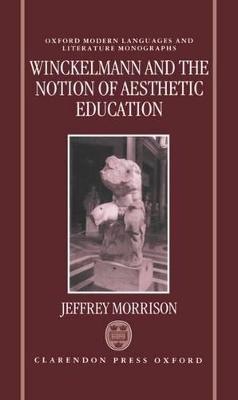
This book examines the pivotal role of Johann Joachim Winckelmann as an arbiter of classical taste. It identifies the key features of Winckelmann's treatment of classical beauty, particularly in his famous descriptions, and investigates his teaching of the appreciation of beauty. The work identifies and examines the point at which theory and descriptive method are merged in a practical attempt to offer aesthetic education. The publications and correspondence of Winckelmann's pupils are offered as criteria for judging the success of his mission, eventually casting doubt upon his concept of aesthetic education, both in theory and practice. The final chapter of the book is concerned with Goethe's reception of Winckelmann, which shows unusual sensitivity to his work's aesthetic core. It also shows how Goethe's own writing on Italy reveals a process of independent aesthetic education akin to Winckelmann's and distinct from his pupils. The work is founded in close textual analysis but also covers the principles of the aesthetic education, the value of the Grand Tour and the role of Rome in the European imagination.
| ISBN: | 9780198159124 |
| Publication date: | 8th August 1996 |
| Author: | Jeffrey Lecturer in German, Lecturer in German, St Patricks College, County Kildare Morrison |
| Publisher: | Clarendon Press an imprint of Oxford University Press |
| Format: | Hardback |
| Pagination: | 288 pages |
| Series: | Oxford Modern Languages and Literature Monographs |
| Genres: |
Theory of art Medieval Western philosophy Philosophy and theory of education History of art Literary studies: c 1600 to c 1800 |
This book examines the pivotal role of Johann Joachim Winckelmann as an arbiter of classical taste. It identifies the key features of Winckelmann's treatment of classical beauty, particularly in his famous descriptions, and investigates his teaching of the appreciation of beauty. The work identifies and examines the point at which theory and descriptive method are merged in a practical attempt to offer aesthetic education. The publications and correspondence of Winckelmann's pupils are offered as criteria for judging the success of his mission, eventually casting doubt upon his concept of aesthetic education, both in theory and practice. The final chapter of the book is concerned with Goethe's reception of Winckelmann, which shows unusual sensitivity to his work's aesthetic core. It also shows how Goethe's own writing on Italy reveals a process of independent aesthetic education akin to Winckelmann's and distinct from his pupils. The work is founded in close textual analysis but also covers the principles of the aesthetic education, the value of the Grand Tour and the role of Rome in the European imagination.
Winckelmann and the Notion of Aesthetic Education features in the following genres: Theory of art, Medieval Western philosophy, Philosophy and theory of education, History of art, Literary studies: c 1600 to c 1800
Winckelmann and the Notion of Aesthetic Education is available in Hardback
Winckelmann and the Notion of Aesthetic Education was written by Jeffrey Lecturer in German, Lecturer in German, St Patricks College, County Kildare Morrison and published by Clarendon Press an imprint of Oxford University Press
Winckelmann and the Notion of Aesthetic Education has 288 pages
Yes it is part of Oxford Modern Languages and Literature Monographs series
£48.99