

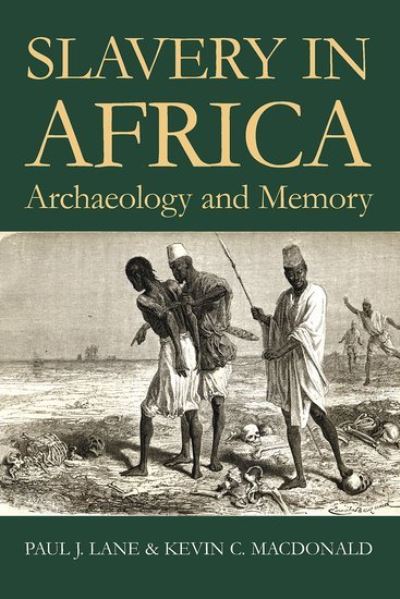
The role and consequences of slavery in the history of Africa have been brought to the fore recently in historical, anthropological and archaeological research. Public remembrances - such as Abolition 2007 in Great Britain, which marked the bicentenary of the Abolition of the Slave Trade Act and which this volume also commemorates - have also stimulated considerable interest. There is a growing realisation that enslavement, whether as part of a sliding scale of 'rights in persons' or due to acts of violence, has a history on the African continent that extends back in time long before the Trans-Atlantic slave trade.
The nature of such enslavement is obscured by the lack of resolution in historical sources before the middle of the second millennium AD. Ground-breaking archaeological research is now building models for approaching slave labour systems via collaboration with historians and the critical scrutiny of historical data. Generally, such new research focuses at the landscape scale; rather than attempting to find physical evidence of slavery per se, it assesses the settlement systems of slavery-based economies, and the depopulation and abandonment which followed from wars of enslavement. The potential utility of this work is considerable, and is ultimately the only means whereby researchers will be able to resolve the many 'chicken-or-egg' issues which beset the historical study of slavery in Africa.
Recent decades have also witnessed an increase in attempts to commemorate and memorialise slavery on the African continent, through a combination of museum displays, historic site interpretation and public history projects. Unfortunately, there are still very few critical discussions of relevant case studies of this kind of public archaeology across the continent, and few examples of good practice. This volume addresses this lack by offering a selection of papers on recent archaeological studies of slavery, slave resistance and their contemporary commemoration, alongside archaeological assessments of the economic, environmental and political consequences of slave trading in a variety of historical and geographical settings.
| ISBN: | 9780197264782 |
| Publication date: | 17th November 2011 |
| Author: | Paul Lane, Kevin C MacDonald |
| Publisher: | The British Academy an imprint of Liverpool University Press |
| Format: | Hardback |
| Pagination: | 468 pages |
| Series: | Proceedings of the British Academy |
| Genres: |
Archaeology by period / region Slavery and abolition of slavery |
The role and consequences of slavery in the history of Africa have been brought to the fore recently in historical, anthropological and archaeological research. Public remembrances - such as Abolition 2007 in Great Britain, which marked the bicentenary of the Abolition of the Slave Trade Act and which this volume also commemorates - have also stimulated considerable interest. There is a growing realisation that enslavement, whether as part of a sliding scale of 'rights in persons' or due to acts of violence, has a history on the African continent that extends back in time long before the Trans-Atlantic slave trade.
The nature of such enslavement is obscured by the lack of resolution in historical sources before the middle of the second millennium AD. Ground-breaking archaeological research is now building models for approaching slave labour systems via collaboration with historians and the critical scrutiny of historical data. Generally, such new research focuses at the landscape scale; rather than attempting to find physical evidence of slavery per se, it assesses the settlement systems of slavery-based economies, and the depopulation and abandonment which followed from wars of enslavement. The potential utility of this work is considerable, and is ultimately the only means whereby researchers will be able to resolve the many 'chicken-or-egg' issues which beset the historical study of slavery in Africa.
Recent decades have also witnessed an increase in attempts to commemorate and memorialise slavery on the African continent, through a combination of museum displays, historic site interpretation and public history projects. Unfortunately, there are still very few critical discussions of relevant case studies of this kind of public archaeology across the continent, and few examples of good practice. This volume addresses this lack by offering a selection of papers on recent archaeological studies of slavery, slave resistance and their contemporary commemoration, alongside archaeological assessments of the economic, environmental and political consequences of slave trading in a variety of historical and geographical settings.
Slavery in Africa features in the following genres: Archaeology by period / region, Slavery and abolition of slavery
Slavery in Africa is available in Hardback
Slavery in Africa was written by Paul Lane, Kevin C MacDonald and published by The British Academy an imprint of Liverpool University Press
Slavery in Africa has 468 pages
Yes it is part of Proceedings of the British Academy series
£85.00