

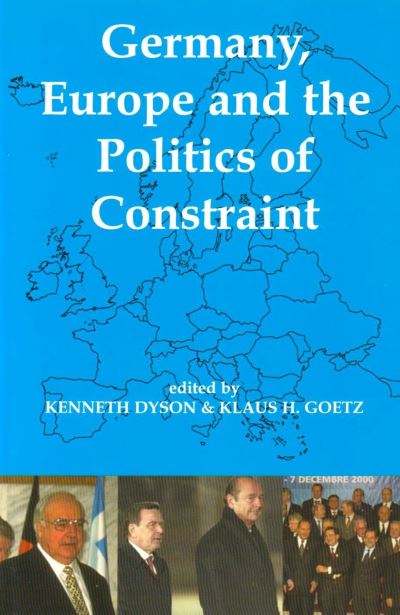
The process of European integration is marked both by continued deepening and widening, and by growing evidence of domestic disquiet and dissent. Against this background, this volume examines three key themes: the challenge to the power of member states - as subjects of European integration - to determine the course of the integrationist project and to shape European public policies; the increasing constraints in the domestic political arena experienced by member states as objects of European integration; and the contestation over both the 'constitutive politics of the EU' and specific policy choices. These three themes - power, constraint and contestation - and their interdependence are explored with specific reference to contemporary Germany.
The main findings call for a revision of the 'conventional wisdom' about Germany's Europeanization experience. First, while Germany continues to engage intensively in all aspects of the integration process, its power to 'upload' - 'hard' and 'soft', 'deliberate' or 'unintentional', 'institutional' or 'ideational' - appears in decline. Germany's capacity to 'shape its regional milieu' is challenged by both changes in the integration process and the ever more apparent weaknesses of the 'German model'. The traditional regional core milieu is shrinking in size and importance in an enlarging Europe, and Germany's milieu-shaping power is being challenged. Second, the coincidence of enabling and constraining effects is being progressively replaced by a discourse that notes unwelcome constrictions associated with EU membership. The book's findings suggest that key political institutions and processes in the Federal Republic have not co-evolved with the integration process, but lead an, at times, uncomfortable co-existence. Third, domestic contestation over both everyday EU policy and the constitutional politics of integration seems set to increase. There are, as yet, no indications that these domestic conflicts will reach an intensity comparable to that of the 1950s. However, both the 'permissive' mass consensus and, perhaps more importantly, élite consensus are being tested to their limits.
This volume is essential reading for students of comparative European politics and German studies.
| ISBN: | 9780197262955 |
| Publication date: | 16th October 2003 |
| Author: | Kenneth H F Dyson, Klaus H Goetz |
| Publisher: | The British Academy an imprint of Liverpool University Press |
| Format: | Hardback |
| Pagination: | 438 pages |
| Series: | Proceedings of the British Academy |
| Genres: |
Political structure and processes International institutions |
The process of European integration is marked both by continued deepening and widening, and by growing evidence of domestic disquiet and dissent. Against this background, this volume examines three key themes: the challenge to the power of member states - as subjects of European integration - to determine the course of the integrationist project and to shape European public policies; the increasing constraints in the domestic political arena experienced by member states as objects of European integration; and the contestation over both the 'constitutive politics of the EU' and specific policy choices. These three themes - power, constraint and contestation - and their interdependence are explored with specific reference to contemporary Germany.
The main findings call for a revision of the 'conventional wisdom' about Germany's Europeanization experience. First, while Germany continues to engage intensively in all aspects of the integration process, its power to 'upload' - 'hard' and 'soft', 'deliberate' or 'unintentional', 'institutional' or 'ideational' - appears in decline. Germany's capacity to 'shape its regional milieu' is challenged by both changes in the integration process and the ever more apparent weaknesses of the 'German model'. The traditional regional core milieu is shrinking in size and importance in an enlarging Europe, and Germany's milieu-shaping power is being challenged. Second, the coincidence of enabling and constraining effects is being progressively replaced by a discourse that notes unwelcome constrictions associated with EU membership. The book's findings suggest that key political institutions and processes in the Federal Republic have not co-evolved with the integration process, but lead an, at times, uncomfortable co-existence. Third, domestic contestation over both everyday EU policy and the constitutional politics of integration seems set to increase. There are, as yet, no indications that these domestic conflicts will reach an intensity comparable to that of the 1950s. However, both the 'permissive' mass consensus and, perhaps more importantly, élite consensus are being tested to their limits.
This volume is essential reading for students of comparative European politics and German studies.
Germany, Europe and the Politics of Constraint features in the following genres: Political structure and processes, International institutions
Germany, Europe and the Politics of Constraint is available in Hardback
Germany, Europe and the Politics of Constraint was written by Kenneth H F Dyson, Klaus H Goetz and published by The British Academy an imprint of Liverpool University Press
Germany, Europe and the Politics of Constraint has 438 pages
Yes it is part of Proceedings of the British Academy series
£81.00