

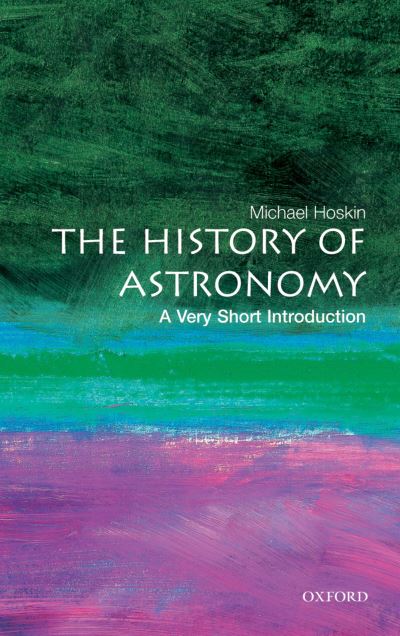
Astronomy, perhaps the first of the sciences, was already well developed by the time of Christ. Seventeen centuries later, after Newton showed that the movements of the planets could be explained in terms of gravitation, it became the paradigm for the mathematical sciences. In the nineteenth century the analysis of star-light allowed astrophysicists to determine both the chemical composition and the radial velocities of celestial bodies, while the development of photography enabled distant objects invisible to the human eye, to be studied and measured in comfort. Technical developments during and since the Second World War have greatly enlarged the scope of the science by permitting the study of radiation. This is a fascinating introduction to the history of Western astronomy, from prehistoric times to the origins of astrophysics in the mid-nineteenth century. Historical records are first found in Babylon and Egypt, and after two millennia the arithmetical astronomy of the Babylonians merged with the Greek geometrical approach to culminate in the Almagest of Ptolemy. This legacy was transmitted to the Latin West via Islam, and led to Copernicus's claim that the Earth is in motion. In justifying this Kepler converted astronomy into a branch of dynamics, leading to Newton's universal law of gravity. The book concludes with eighteenth- and nineteenth-century applications of Newton's law, and the first explorations of the universe of stars. ABOUT THE SERIES: The Very Short Introductions series from Oxford University Press contains hundreds of titles in almost every subject area. These pocket-sized books are the perfect way to get ahead in a new subject quickly. Our expert authors combine facts, analysis, perspective, new ideas, and enthusiasm to make interesting and challenging topics highly readable.
| ISBN: | 9780192803061 |
| Publication date: | 8th May 2003 |
| Author: | Michael Hoskin |
| Publisher: | Oxford University Press an imprint of OUP OXFORD |
| Format: | Paperback |
| Pagination: | 123 pages |
| Series: | A Very Short Introduction |
| Genres: |
History of science Popular Science Popular astronomy and space Astronomy, space and time |
Astronomy, perhaps the first of the sciences, was already well developed by the time of Christ. Seventeen centuries later, after Newton showed that the movements of the planets could be explained in terms of gravitation, it became the paradigm for the mathematical sciences. In the nineteenth century the analysis of star-light allowed astrophysicists to determine both the chemical composition and the radial velocities of celestial bodies, while the development of photography enabled distant objects invisible to the human eye, to be studied and measured in comfort. Technical developments during and since the Second World War have greatly enlarged the scope of the science by permitting the study of radiation. This is a fascinating introduction to the history of Western astronomy, from prehistoric times to the origins of astrophysics in the mid-nineteenth century. Historical records are first found in Babylon and Egypt, and after two millennia the arithmetical astronomy of the Babylonians merged with the Greek geometrical approach to culminate in the Almagest of Ptolemy. This legacy was transmitted to the Latin West via Islam, and led to Copernicus's claim that the Earth is in motion. In justifying this Kepler converted astronomy into a branch of dynamics, leading to Newton's universal law of gravity. The book concludes with eighteenth- and nineteenth-century applications of Newton's law, and the first explorations of the universe of stars. ABOUT THE SERIES: The Very Short Introductions series from Oxford University Press contains hundreds of titles in almost every subject area. These pocket-sized books are the perfect way to get ahead in a new subject quickly. Our expert authors combine facts, analysis, perspective, new ideas, and enthusiasm to make interesting and challenging topics highly readable.
The History of Astronomy features in the following genres: History of science, Popular Science, Popular astronomy and space, Astronomy, space and time
The History of Astronomy is available in Paperback
The History of Astronomy was written by Michael Hoskin and published by Oxford University Press an imprint of OUP OXFORD
The History of Astronomy has 123 pages
Yes it is part of A Very Short Introduction series
£8.99