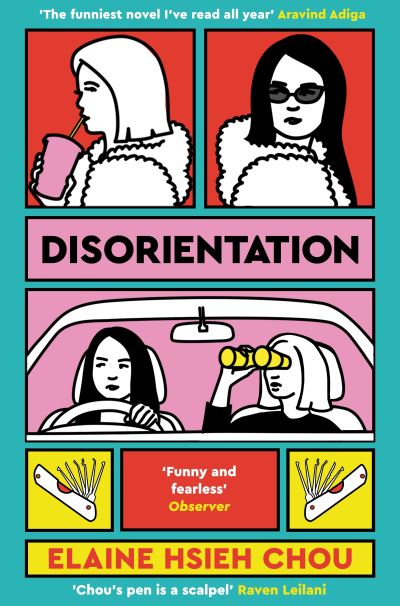
"Disorientation reads like a tongue-in-cheek satire novel, but behind the sardonic façade exists a complex web of meaningful commentary. Think Don't Look Up but in a literary setting with much more Asian American representation and a less dire ending."
Disorientation reads like a tongue-in-cheek satire novel, but behind the sardonic façade exists a complex web of meaningful commentary. Think Don't Look Up but in a literary setting with much more Asian American representation and a less dire ending.
Chou is very intentional with her writing. It's hard not to be drawn in by the eloquent way in which she writes about literature and poetry from the initial pages. I was immediately transfixed. But once the scandal breaks out, Chou's writing takes on a sharpness that almost mimics the tumult of the plot.
The prose becomes interspersed with different writing styles, from essays about modern day colonialism to documentary transcripts to playwriting. It might seem chaotic but I enjoyed the dynamism of this literary mishmash.
Also intriguing about this consciousness-awakening caper, is its use of characterisation. Chou leverages her characters as symbols which represent different groups in society.
Ingrid, the main character, is a docile, insufferably meek woman who always tries to please, prioritising the comfort of others above her own, including former abusive partners. She undergoes a journey of social clarity, becoming more and more aware of the unequal race dynamics that exist in Western society. Dismissive at first, she slowly starts to question her relationship to white men and the ways in which she has learnt to internalize white dominant ideals concerning race over time.
Similarly, characters such as Vivian and Timothy felt like plot devices but with a surprising amount of substance. Vivian is the typical embodiment of the contemporary social rights' activist; queer, millennial, staunchly opposed to the patriarchy and partial to things like meditation and therapy. Timothy on the other hand, is a representation of the ethnic minority people who reject the existence of racial inequality, asserting that one only needs to pull up their 'bootstraps' in order to get ahead and derides the so-called divisive identity politics that Vivian upholds.
The dichotomy of these two characters provides a pointed look into the spiraling 'culture wars' of our times. Amidst this furore of contention, Ingrid is not sure exactly where she fits in all this. What felt so human and believable about Ingrid in this context is the fact that she doesn't just suddenly become an expert on arguing the racialised imbalances that synonymize society.
She's constantly learning more, becoming more politically invested but she sometimes gets it wrong and doesn't always know how to respond to the counter arguments that are raised by her best friend Eunice and her parents.
And then we have the characterisation of Ingrid's fiancé, Stephen and her advisor, Michael, through which Chou makes some poignant observations about white masculinity and the dominant role it plays in society.
Disorientation seeks to disrupt and destabilise reader perceptions, disorienting Orientalism and on this front I think it succeeded. I found it to be a contentious yet comedic character study and a bold debut.
'The funniest, most poignant novel of the year' - VogueFor fans of Yellowface by Rebecca F Kuang, Disorientation is an uproarious and big-hearted satire - alive with sharp edges, immense warmth, and a cast of unforgettable characters - that asks: who gets to tell our stories? Ingrid Yang is desperate to finish her PhD dissertation on the much-lauded poet Xiao-Wen Chou and never read about 'Chinese-y' things again, when she accidentally stumbles upon a strange note in the Chou archives that she thinks may be her ticket out of academic hell.But Ingrid has no idea that the note will lead to an explosive secret, upending her entire life and the lives of those around her. Her clumsy exploits to discover the truth set off a rollercoaster of mishaps and misadventures, from campus protests and over-the-counter drug hallucinations, to book burnings and a movement that stinks of Yellow Peril propaganda. In the aftermath, she'll have to question everything, from her relationship with her fiancé to the kind of person she dares to be.'The funniest novel I've read all year' - Aravind Adiga, author of The White Tiger'Fearless' - Observer'Elaine Hsieh Chou's pen is a scalpel' - Raven Leilani, author of Luster
| Primary Genre | Modern and Contemporary Fiction |
| Other Genres: | |
| Recommendations: |
'The funniest, most poignant novel of the year' - VogueFor fans of Yellowface by Rebecca F Kuang, Disorientation is an uproarious and big-hearted satire - alive with sharp edges, immense warmth, and a cast of unforgettable characters - that asks: who gets to tell our stories? Ingrid Yang is desperate to finish her PhD dissertation on the much-lauded poet Xiao-Wen Chou and never read about 'Chinese-y' things again, when she accidentally stumbles upon a strange note in the Chou archives that she thinks may be her ticket out of academic hell.But Ingrid has no idea that the note will lead to an explosive secret, upending her entire life and the lives of those around her.
Disorientation features in the following genres: Modern and Contemporary Fiction, Debuts, Student life, Narrative theme: Politics, Satirical style / satire, General Fiction, Fiction, Recommendations, Advice on education, Self Help and Personal Development, Health & Fitness, Fiction: narrative themes, Styles (S), Style qualifiers, Sharing Diverse Voices
Paperback, Hardback, Ebook. £8.99, down from the £9.99 cover price. In Stock.
Disorientation was written by Elaine Hsieh Chou and published by Picador an imprint of Pan Macmillan
Disorientation has 416 pages
£8.99, reduced from £9.99. In Stock.