

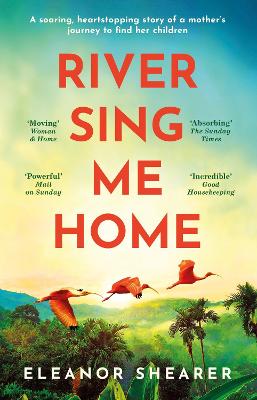
Rachel's quest is driven by a mother's love for what was taken from her. The indomitable desire to reunite her family wills the reader to root for her in her search.
River Sing Me Home is about the passionate strength of a mother's love for her children and her desire to find them even when fearful for her own freedom. After a fast-paced opening creating an ongoing sense of trepidation for her recapture that carries throughout the novel, Rachel encounters help in the form of others who recognise the desperation in her search. Finding kindness from a cast of supporting characters we follow her journey through the streets of Bridgetown in Barbados, the Demerara river and forests of British Guiana and onto the plantations of Trinidad. The love she feels for her children is evident in the narrative, as is the compassion of the companions joining her during her quest. I enjoyed the book which showed a different side to the end of slavery that I had never encountered before, one of a family separated by force and a desire to reunite yet still facing many hurdles while trying to do so.
Join Rachel's tearjerking quest to find her children as slavery is abolished in this beautiful book about fractured families, freedom, loss and love.
The story begins in the Providence Plantation in Barbados 1834 and the law says her people are free. The end of slavery is here and Rachel is desperate to find her children. Except it's not quite over; slavery continues to cast its shadow long after it's formal end.
No longer slaves, they are now his apprentices. No one can leave. Freedom is just another name for the life they have always lived. So Rachel runs.
We hear Rachel's unique voice spoken in her dialect throughout the book and as she shares her story with us, we are transported to Barbados. We wonder at her strength. We mourn her 11 "pickney" with her. Every loss, every life, every hole in her heart as her children were wrenched away from her. We hope for her, we stand strong with her as she travels across the Caribbean to find her five children who were sold. These are the stories of Mary Grace, Micah, Thomas Augustus, Cherry Jane and Mercy. And above all this is the story of Rachel and the faces she cannot forget, the lost children who haunt her every waking hour. "Freedom mean something different to me. The search, that is the freedom". Consumed with the extraordinary lengths to which a mother will go to find her children, this is a remarkable debut.
A gripping and tragic tale contrasting the evil and cruelty of slavery with hope and love.
This is a gripping story set in the Caribbean as slavery ended in England. There are terrible stories of individual slaves told, as Rachel, a 40 year old field hand runs away as slavery was abolished in England to find her surviving children, who were all sold or had died. The hunt takes us from Barbados to Demerara and Trinidad. As expected, the stories are harrowing, from one who at the age of 16 joined the rebellion for freedom at the nominal end of slavery to another, who is a selective mute after unstated but implied atrocities committed against her. The book, while fiction, has an element of a history lesson as each child has taken a different path to seek and fight for freedom in a time of extreme injustice. Many of the issues that arise are topical, such as how people can cope when all the world is against them and therefore they expect nothing and deny hope, to the vulnerability that hope brings. While there is tragedy, there is also love and hope and enormous bravery demonstrated.
Set in Barbados soon after the end of slavery has been declared, this is the story of Rachel, who embarks on a determined search for her children. It raises issues which are still relevant today.
It is unusual to have a book about the immediate aftermath of the emancipation of slaves in the Caribbean.
River Sing me Home is Eleanor Shearer’s first book and the story catches the imagination from the start. Rachel starts out in a plantation in Barbados in 1834 when the slave owner tells the slaves that the King has declared the end of slavery. But freedom does not look likely to change their lives dramatically and Rachel decides to take her fate into her own hands and embark on a determined search for the children to whom she gave birth, but who were then taken away from her.
The story maintains interest from the beginning to the end. I found some of the language strained, with deep and meaningful silences portrayed at various points. The author also struggles to portray the use of patois, with constant use of phrases such as ‘me think..’ and ‘they don’ …’. However, I was attracted to the characters in the book and concerned to know how the story ended for them. This is an interesting book, an enjoyable choice for our book group with plenty of issues to discuss.
The book was an enjoyable read though I was not very keen on the dialect, however I can see that it established the time and place of the novel. I would recommend it to friends.
The book follows the journey of Rachel, searching for her children taken from her in the time of slavery. Though slavery has ended in theory the freed slaves are still controlled by the owners of the slave plantations. Rachel takes the decision to ‘escape’ and search for her five surviving children. This takes her on a long and dangerous journey with many encounters on the way.
I enjoyed the book, it was an easy read, sparked my interest in following her journey through Barbados, British Guyana and Trinidad and it prompted me to
research the process of emancipation which was clearly not real freedom at all but totally slewed to protect the interests of the white plantation owners.
The description of a plantation was interesting, described as designed with no place to hide. We met some fascinating characters in the way, I enjoyed the descriptions of several of the peripheral characters, Hope, the Armstrongs, mama B, the authors character sketches were good.
A heart wrenching tale of love, loss, hope and reunion in the Caribbean soon after the end of slavery.
A fascinating glimpse into the lives of those forced into slavery forging new lives as the world around them was starting to change.
When she hears the King has declared the end of slavery, Rachel finally finds the courage to search for her missing children whose memories have haunted her for years.
Along the way she finds help and friendship in unusual places but soon realises changes are slow to filter through to the plantations.
Rachel discovers her children’s lives all took very different courses and amid the heartache finds peace and hope for the future.
A rarely addressed aspect of slavery told through the experience of a mother’s search across the Caribbean for her ‘lost’ children
This is not a book I would have usually chosen to read however, once I began I did appreciate that it addressed aspects of the slave trade that I hadn’t considered before and this spiked my interest. Searching across the Caribbean it takes the reader on a long and at times harrowing journey through a woman’s experience of motherhood within slavery and the aftermath of ‘freedom’ both for herself and her children. I appreciated the range of perspectives that were explored through its strong cast of characters which on the whole kept me engaged with their lives. There does appear to be a compressed time scale with children being traced over what might seem to be an unrealistically short period, but I was willing to suspend disbelief as the story carried me along. Although descriptive passages are my least favourite elements in most things I read I think that those who do appreciate these as enriching factors in a narrative will find their experience enhanced by the vivid depiction of the changing locations and differing terrains experienced by Rachel and her companions.
Rachel’s quest to escape from enslavement, search for her stolen children is at times harrowing, at times joyful and often fraught with danger. Her story will open your heart.
I found this book a compelling read, describing of the life of a runaway slave and her will to survive. At the beginning of the book Rachel, a forty year old woman, born into slavery but not broken by it, runs away from being an ‘apprentice’. Although set at the time of the abolision of slavery, Rachel is still owned by a plantation owner on Barbados. Her physical and emotional journey is vividly portrayed as is her strength of character as she searches for her five surviving children. As she moves from Island to island in her quest there is a recurring theme of periods of stability countered by periods of extreme danger of being discovered and sent back to work on the plantation she escaped from. This made the book for me a real ‘page turner’. The book was inspired by the true story of Mother Rachael, one of the many women who walked away from the plantations to search for their children and the author draws on the experience of her own family members, past and present, to create the fictional Rachel and bring their story to life. The juxtaposition of a quiet, watchful woman yet full of love and strength shines out in this heart-rending story. Rachel’s story stayed with me long after I reached the last page.
This is a powerful, emotional yet harrowing story about a families’ search for freedom in Barbados in 1834 at the end of slavery.
A powerful, emotional story, set in Barbados in 1834 at the end of slavery.
Some wonderfully descriptive passages help the reader to visualise and empathise with the plight of Rachel, the Mother, who runs away from the plantation in search of her children. A roller coaster of feelings, from anticipation, excitement, purpose, sadness, grief and fear hold the reader in suspense throughout the book.
Thoroughly enjoyable and insightful into this period in all our history.
River Sing Me Home immediately drew me into the lives of Rachel and her children with her descriptive prose. The author’s maternal love and desperate searching made the novel easy to finish but at times heartbreaking to read. Thoroughly enjoyable and insightful into this period in all our history.
Interesting and heartbreaking at the same time.
The subject matter was very interesting and I learnt a great deal about slavery and that period of history that I did not know before. It was interesting and heartbreaking at the same time. I cared about Rachel and what happened to her. I found the author’s style a bit basic at times. Overall a good read.
Instantly gripped, beautiful written
Instantly gripped, beautiful written, Shearer cleverly shares insight into the life of a family fragmented by slavery but brilliantly depicts the loving bonds that lie within Rachel and her children. This book leaves the reader with great appreciation that no matter how far apart, the innate characteristics that Rachel's children display, are demonstrated by Rachel herself through her persistent and tireless journey to reunite her family.
A moving and emotive story about a mother's brave, resilient and relentless search for all her lost children after an end to slavery was decreed.
A moving and emotive story about a mother's brave, resilient and relentless search for all her lost children after an end to slavery was decreed. Compelling descriptions about how contrasting ways of life for captives in the Caribbean evolved and how in reality freedom was not granted for many. The love, kindness and understanding between survivors of this time is uplifting.
I found the story gripping and found it hard to put the book down.
The faces Rachel cannot forget was a touching, sad but at the same time hopeful story dealing with an aspect of slavery - post abolition, that was new to me. I found the story gripping and found it hard to put the book down as I accompanied Rachel in her search for her children.
I enjoyed the book and found it both heartbreaking and beautiful to read.
I enjoyed the book and found it both heartbreaking and beautiful to read. The characters were mostly well developed, although not all, as a few were not expanded upon and left the reader feeling like the author had run out of time or direction. The structures was easy to read but sometimes felt too linear and lacked layers. All in all I thought it was a remarkable debut novel and found it engaging and easy to read, even though the subject at the heart of the story was hard to digest, as it is a stark reminder of the brutal history of slavery. I look forward to more of the author’s work.
What it meant to be a mother during this awful period in history is beautifully, but also painfully, evoked by Shearer
What it meant to be a mother during this awful period in history is beautifully, but also painfully, evoked by Shearer as you follow Rachel’s incredible journey to find her children, displaced by slavery. What she, and so many mothers in history must have endured seems unimaginable, but surprisingly the book also manages to find so much love, determination and hope as the stories of this family come together. I hope Shearer writes more about her family heritage.
A real page turner, a tale of the strength of maternal love
I knew very little about the immediate aftermath of slavery and nothing of the search for lost children before reading River Sing Me Home. I leave it feeling I know a little more. I found the book to be a real page turner, a tale of the strength of maternal love. At times I was irked by the lack of character development, for instance Rachel’s mixed race daughter was given only a few pages.
An extremely powerful read
This isn’t an easy read, but not in the way you might expect, as it is not a book about slavery. It's about Rachel's journey, who is determined to find her children - no matter what it takes. It's probably one of the first books I've read about what life and freedom may have looked like once slavery came to its end. It's a beautiful and painful representation of what comes after slavery. Towards the end of the book the descriptions become a bit too detailed and I would have loved for the writer to tell us more about the character Cherry Jane. The ending feels terribly convenient and unrealistic, but understandable for what the writer is trying to do. An extremely powerful read that despite its flaws will give you a good insight into how Rachel makes freedom for herself in so many ways.
A rarely addressed aspect of slavery told through the experience of a mother’s search across the Caribbean for her ‘lost’ children
This is not a book I would have usually chosen to read however, once I began I did appreciate that it addressed aspects of the slave trade that I hadn’t considered before and this spiked my interest. Searching across the Caribbean it takes the reader on a long and at times harrowing journey through a woman’s experience of motherhood within slavery and the aftermath of ‘freedom’ both for herself and her children. I appreciated the range of perspectives that were explored through its strong cast of characters which on the whole kept me engaged with their lives. There does appear to be a compressed time scale with children being traced over what might seem to be an unrealistically short period, but I was willing to suspend disbelief as the story carried me along. Although descriptive passages are my least favourite elements in most things I read I think that those who do appreciate these as enriching factors in a narrative will find their experience enhanced by the vivid depiction of the changing locations and differing terrains experienced by Rachel and her companions.