

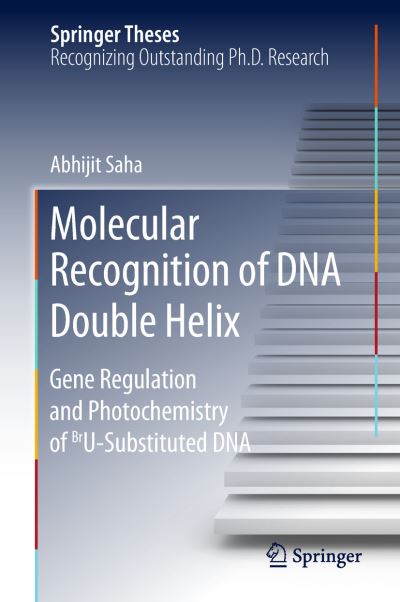
In this book, the molecular recognition of DNA using small molecules is discussed, with a study of the photochemistry of BrU-labeled DNA. The purposes of the study were to develop small molecules for regenerative medicine, to develop a method to detect the recognition site of small molecules, and to detect the most important biological phenomena using the photochemistry of BrU-labeled DNA. The study began with the design and development of small molecules that can induce pluripotency genes. To deal with the important issue of cell permeability of the original compound, a new analogue of the original with improved gene expression was designed and synthesized. Using the photochemistry of BrU-labeled DNA, crucial biological phenomena such as cooperativity between transcription factors were detected. For the first time, the cooperativity was examined by excess electron transfer assay. DNA was also studied very carefully in order to understandthe mechanism of the double-strand break in the UVA micro-irradiation technique. The mechanism of the double strand remained untouched. Nevertheless, the double-strand break mechanism was clearly demonstrated by Hoechst dye, as shown in this book.
| ISBN: | 9789811087455 |
| Publication date: | 4th April 2018 |
| Author: | Abhijit Saha |
| Publisher: | Springer an imprint of Springer Nature Singapore |
| Format: | Hardback |
| Pagination: | 114 pages |
| Series: | Springer Theses |
| Genres: |
Organic chemistry Engineering applications of bio-materials Regenerative medicine Biochemistry Biotechnology |
In this book, the molecular recognition of DNA using small molecules is discussed, with a study of the photochemistry of BrU-labeled DNA. The purposes of the study were to develop small molecules for regenerative medicine, to develop a method to detect the recognition site of small molecules, and to detect the most important biological phenomena using the photochemistry of BrU-labeled DNA. The study began with the design and development of small molecules that can induce pluripotency genes. To deal with the important issue of cell permeability of the original compound, a new analogue of the original with improved gene expression was designed and synthesized. Using the photochemistry of BrU-labeled DNA, crucial biological phenomena such as cooperativity between transcription factors were detected. For the first time, the cooperativity was examined by excess electron transfer assay. DNA was also studied very carefully in order to understandthe mechanism of the double-strand break in the UVA micro-irradiation technique. The mechanism of the double strand remained untouched. Nevertheless, the double-strand break mechanism was clearly demonstrated by Hoechst dye, as shown in this book.
Molecular Recognition of DNA Double Helix features in the following genres: Organic chemistry, Engineering applications of bio-materials, Regenerative medicine, Biochemistry, Biotechnology
Molecular Recognition of DNA Double Helix is available in Hardback
Molecular Recognition of DNA Double Helix was written by Abhijit Saha and published by Springer an imprint of Springer Nature Singapore
Molecular Recognition of DNA Double Helix has 114 pages
Yes it is part of Springer Theses series