

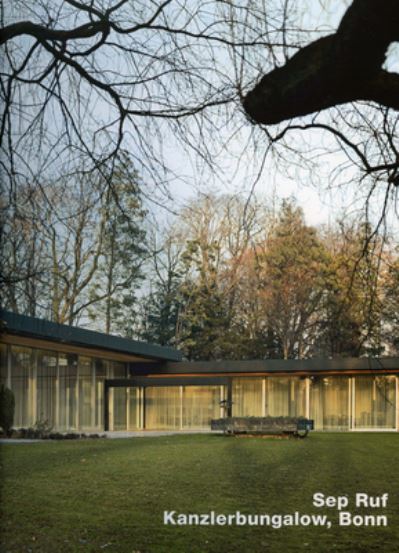
Text in English & German. The German Chancellor's former residential and reception building in Bonn is one of the German post-war period's most significant high-profile buildings. The "Kanzlerbungalow" was built 1963/64. The idea was Ludwig Erhard's, and it was planned by Munich architect Sep Ruf. Along with the buildings by Hans Schwippert, Egon Eiermann and Günter Behnisch, it is among the most outstanding architectural reminders of Bonn's time as the Federal Republic's capital. Situated in the park of Palais Schaumberg close to the Rhine's banks, the building could not be seen by the general public and therefore remained comparatively unknown. The Kanzlerbungalow combines its function of representing the state with that of a home. It shows classical modern influences -- primarily that of Ludwig Mies van der Rohe -- extending to the contemporary Californian "Case Study Houses". The building speaks volumes about the early Federal Republic's sense of its own identity. The question of how the still young democracy should represent itself in its architecture after the years of National Socialism found its answer with a design that combined the need for an appropriate setting for a high public function with an explicit desire to make use of the tools created by the International Style, rather than resort to outmoded formal gestures which had additionally been politically discredited by recent history. The reaction to Sep Ruf's building reflects the often undecided attitude to questions of appropriate state representation of the time. Much praised by architectural experts, the Kanzlerbungalow did not appeal to a number of Erhard's successors. It did however have a not insignificant influence on West German architects in particular, in spite of its very specialised function. It is presently undergoing extensive renovations, and is to be used for exhibitions and other purposes from 2009 onwards.
| ISBN: | 9783932565724 |
| Publication date: | 1st March 2022 |
| Author: | Andreas Schätzke, Joaquín Medina Warmburg, Paul Swiridoff |
| Publisher: | Edition Axel Menges |
| Format: | Hardback |
| Pagination: | 47 pages |
| Series: | Opus |
| Genres: |
Architecture: public, commercial and industrial buildings |
Text in English & German. The German Chancellor's former residential and reception building in Bonn is one of the German post-war period's most significant high-profile buildings. The "Kanzlerbungalow" was built 1963/64. The idea was Ludwig Erhard's, and it was planned by Munich architect Sep Ruf. Along with the buildings by Hans Schwippert, Egon Eiermann and Günter Behnisch, it is among the most outstanding architectural reminders of Bonn's time as the Federal Republic's capital. Situated in the park of Palais Schaumberg close to the Rhine's banks, the building could not be seen by the general public and therefore remained comparatively unknown. The Kanzlerbungalow combines its function of representing the state with that of a home. It shows classical modern influences -- primarily that of Ludwig Mies van der Rohe -- extending to the contemporary Californian "Case Study Houses". The building speaks volumes about the early Federal Republic's sense of its own identity. The question of how the still young democracy should represent itself in its architecture after the years of National Socialism found its answer with a design that combined the need for an appropriate setting for a high public function with an explicit desire to make use of the tools created by the International Style, rather than resort to outmoded formal gestures which had additionally been politically discredited by recent history. The reaction to Sep Ruf's building reflects the often undecided attitude to questions of appropriate state representation of the time. Much praised by architectural experts, the Kanzlerbungalow did not appeal to a number of Erhard's successors. It did however have a not insignificant influence on West German architects in particular, in spite of its very specialised function. It is presently undergoing extensive renovations, and is to be used for exhibitions and other purposes from 2009 onwards.
Sep Ruf, Kanzlerbungalow, Bonn features in the following genres: Architecture: public, commercial and industrial buildings
Sep Ruf, Kanzlerbungalow, Bonn is available in Hardback
Sep Ruf, Kanzlerbungalow, Bonn was written by Andreas Schätzke, Joaquín Medina Warmburg, Paul Swiridoff and published by Edition Axel Menges
Sep Ruf, Kanzlerbungalow, Bonn has 47 pages
Yes it is part of Opus series