

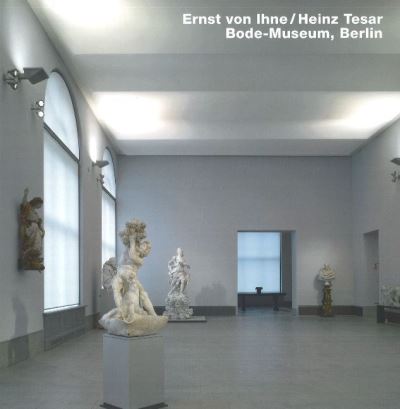
Text in English and German. Heinz Tesar has carefully preserved the existing Bode Museum building on the Museum Island in Berlin, and provided it with highly unusual additional sections for the anticipated hordes of visitors. His work proved its extraordinary qualities even at the opening. There is scarcely anywhere else in the world where the contrasting styles arising from a museum's various building periods come together to form such an individual whole, at best comparable in its density with the Italian architect Carlo Scarpa's museum designs. The essential basis for this successful symbiosis of heterogeneous stylistic elements is the variable historical architecture that museum director Wilhelm Bode invited architect Ernst Eberhard von Ihne to develop around 1900 for the collections, which were very disparate in both style and genre. When the museum opened in 1904, the magnificent architecture still had a political message to proclaim. It was called the 'Kaiser-Friedrich-Museum' at first, and there was a definite programme behind this: invoking the name of the art-minded earlier emperor and erecting ostentatious equestrian statues of figures from Prussian history was intended as a powerful pictorial display to anchor the Prussian dynasty in German history and European culture. But as Ihne eschewed any sense of regional identification, the museum could have carried his name after the abolition of the monarchy. But it was renamed Bode-Museum after its inventor Wilhelm von Bode in the GDR years, which indicates the significance of the stylistic spaces Bode created for the development of exhibition techniques. The text in the book provides a reminder of museum's first collection, a mixed one consisting of paintings, sculpture and furniture. The pictorial section then records the present content of the restored galleries, shaped by Heinz Tesar and using objects from the sculpture collection, the Byzantine museum and the numismatic collection. Tesar carried out some architectural interventions of considerable sculptural quality in the new basement under the small dome, in other words in the rotunda where the planned underground passage from the Pergamon-Museum will come in, and in the new stairwell added as a slim section in one of the courtyards.
| ISBN: | 9783932565632 |
| Publication date: | 10th December 2007 |
| Author: | Gottfried Knapp, Reinhard Görner, Christian Richters |
| Publisher: | Edition Axel Menges |
| Format: | Hardback |
| Pagination: | 63 pages |
| Series: | Opus |
| Genres: |
Individual architects and architectural firms |
Text in English and German. Heinz Tesar has carefully preserved the existing Bode Museum building on the Museum Island in Berlin, and provided it with highly unusual additional sections for the anticipated hordes of visitors. His work proved its extraordinary qualities even at the opening. There is scarcely anywhere else in the world where the contrasting styles arising from a museum's various building periods come together to form such an individual whole, at best comparable in its density with the Italian architect Carlo Scarpa's museum designs. The essential basis for this successful symbiosis of heterogeneous stylistic elements is the variable historical architecture that museum director Wilhelm Bode invited architect Ernst Eberhard von Ihne to develop around 1900 for the collections, which were very disparate in both style and genre. When the museum opened in 1904, the magnificent architecture still had a political message to proclaim. It was called the 'Kaiser-Friedrich-Museum' at first, and there was a definite programme behind this: invoking the name of the art-minded earlier emperor and erecting ostentatious equestrian statues of figures from Prussian history was intended as a powerful pictorial display to anchor the Prussian dynasty in German history and European culture. But as Ihne eschewed any sense of regional identification, the museum could have carried his name after the abolition of the monarchy. But it was renamed Bode-Museum after its inventor Wilhelm von Bode in the GDR years, which indicates the significance of the stylistic spaces Bode created for the development of exhibition techniques. The text in the book provides a reminder of museum's first collection, a mixed one consisting of paintings, sculpture and furniture. The pictorial section then records the present content of the restored galleries, shaped by Heinz Tesar and using objects from the sculpture collection, the Byzantine museum and the numismatic collection. Tesar carried out some architectural interventions of considerable sculptural quality in the new basement under the small dome, in other words in the rotunda where the planned underground passage from the Pergamon-Museum will come in, and in the new stairwell added as a slim section in one of the courtyards.
Ernst Von Ihne/Heinz Tesar, Bode Museum, Berlin features in the following genres: Individual architects and architectural firms
Ernst Von Ihne/Heinz Tesar, Bode Museum, Berlin is available in Hardback
Ernst Von Ihne/Heinz Tesar, Bode Museum, Berlin was written by Gottfried Knapp, Reinhard Görner, Christian Richters and published by Edition Axel Menges
Ernst Von Ihne/Heinz Tesar, Bode Museum, Berlin has 63 pages
Yes it is part of Opus series
£7.65