

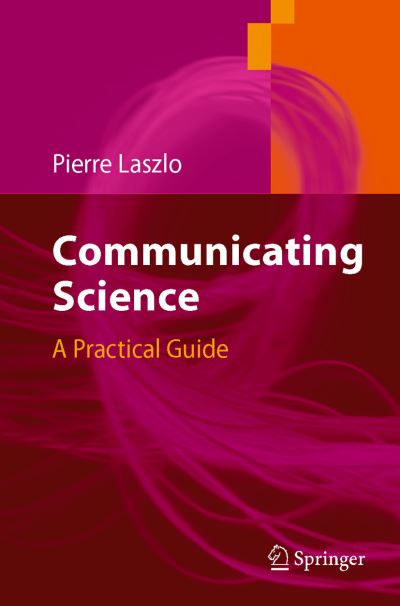
Have you new and interesting, or even outstanding, scientific results that you want to be recognized by your scientific colleagues, or be understood by the public? Or do you want to address decision makers to change their minds? Then, Laszlo's Communicating Science may be the book to consult.
It has two main parts, corresponding to the type of communication task at hand: addressing peers and the general public, plus a third briefer section on how to inform decision-makers.
Each of the main parts is subdivided into two sections, Guidelines and Genres, with entries arranged in alphabetical order. The guidelines are devoted to entries such as acronyms, active or passive voice, body language, figures and captions, introduction, irony, and taking the floor. Within genres, all possible media of communicating science are treated, e.g. the after-dinner speech, conference presentation, keynote lecture, magazine article, research proposal, and teleconference.
Laszlo, a professional scientist, had a career embracing both academia and industrial consulting. He has extensive experience in authoring and editing papers, books and popular science books and conveys his skills as a communicator in this concise guide. The book is geared to engineers and scientists, educators and journalists, science administrators and the medical profession, editors and publishers, whether native or non-native-speakers - in short to anyone having to convert scientific data into an easily intelligible and interesting narrative.
| ISBN: | 9783540319191 |
| Publication date: | 17th July 2006 |
| Author: | Pierre Laszlo |
| Publisher: | Springer an imprint of Springer Berlin Heidelberg |
| Format: | Paperback |
| Pagination: | 214 pages |
| Genres: |
Interdisciplinary studies Medical research Life sciences: general issues Chemistry Medicine: general issues Mathematics and Science |
Have you new and interesting, or even outstanding, scientific results that you want to be recognized by your scientific colleagues, or be understood by the public? Or do you want to address decision makers to change their minds? Then, Laszlo's Communicating Science may be the book to consult.
It has two main parts, corresponding to the type of communication task at hand: addressing peers and the general public, plus a third briefer section on how to inform decision-makers.
Each of the main parts is subdivided into two sections, Guidelines and Genres, with entries arranged in alphabetical order. The guidelines are devoted to entries such as acronyms, active or passive voice, body language, figures and captions, introduction, irony, and taking the floor. Within genres, all possible media of communicating science are treated, e.g. the after-dinner speech, conference presentation, keynote lecture, magazine article, research proposal, and teleconference.
Laszlo, a professional scientist, had a career embracing both academia and industrial consulting. He has extensive experience in authoring and editing papers, books and popular science books and conveys his skills as a communicator in this concise guide. The book is geared to engineers and scientists, educators and journalists, science administrators and the medical profession, editors and publishers, whether native or non-native-speakers - in short to anyone having to convert scientific data into an easily intelligible and interesting narrative.
Communicating Science features in the following genres: Interdisciplinary studies, Medical research, Life sciences: general issues, Chemistry, Medicine: general issues, Mathematics and Science
Communicating Science is available in Paperback
Communicating Science was written by Pierre Laszlo and published by Springer an imprint of Springer Berlin Heidelberg
Communicating Science has 214 pages