

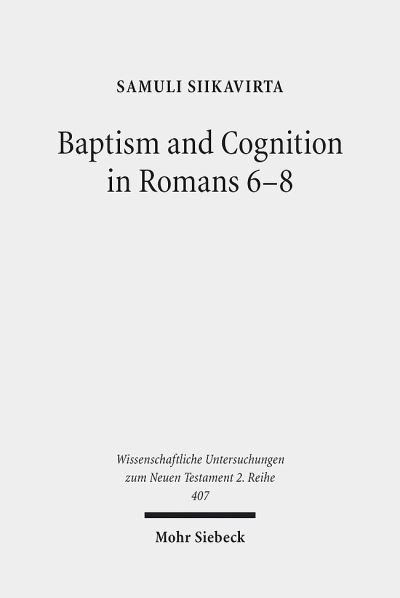
Baptism, for Paul, is a christological event that he also uses in his ethical argument. The discussion of the relationship between Paul's theology and ethics has made use of the terms 'indicative' and 'imperative' since Wernle and Bultmann. As subsequent discussion has shown, these terms are problematic not only because of their rigidity and ambiguity. In this study, Samuli Siikavirta focuses on Romans 6-8, the key text for the interplay between Paul's theological and ethical material. He brings the discussion back to what he sees as central to this interaction: baptism and its cognition. Both elements are examined in their Jewish and Stoic settings. Death to sin, slavery to God, holiness and the indwelling of the Spirit are all seen as integral parts of the baptismal state that is deeply christological rather than symbolical. Paul's cognitive language is then viewed in light of his desire to remind his addressees of who and whose they are because of their baptism.
| ISBN: | 9783161540141 |
| Publication date: | 5th November 2015 |
| Author: | Tobias BrauneKrickau |
| Publisher: | Mohr Siebeck |
| Format: | Paperback |
| Pagination: | 214 pages |
| Series: | Wissenschaftliche Untersuchungen Zum Neuen Testament 2.Reihe |
| Genres: |
Criticism and exegesis of sacred texts Christianity |
Baptism, for Paul, is a christological event that he also uses in his ethical argument. The discussion of the relationship between Paul's theology and ethics has made use of the terms 'indicative' and 'imperative' since Wernle and Bultmann. As subsequent discussion has shown, these terms are problematic not only because of their rigidity and ambiguity. In this study, Samuli Siikavirta focuses on Romans 6-8, the key text for the interplay between Paul's theological and ethical material. He brings the discussion back to what he sees as central to this interaction: baptism and its cognition. Both elements are examined in their Jewish and Stoic settings. Death to sin, slavery to God, holiness and the indwelling of the Spirit are all seen as integral parts of the baptismal state that is deeply christological rather than symbolical. Paul's cognitive language is then viewed in light of his desire to remind his addressees of who and whose they are because of their baptism.
Baptism and Cognition in Romans 6-8 features in the following genres: Criticism and exegesis of sacred texts, Christianity
Baptism and Cognition in Romans 6-8 is available in Paperback
Baptism and Cognition in Romans 6-8 was written by Tobias BrauneKrickau and published by Mohr Siebeck
Baptism and Cognition in Romans 6-8 has 214 pages
Yes it is part of Wissenschaftliche Untersuchungen Zum Neuen Testament 2.Reihe series
£80.46