

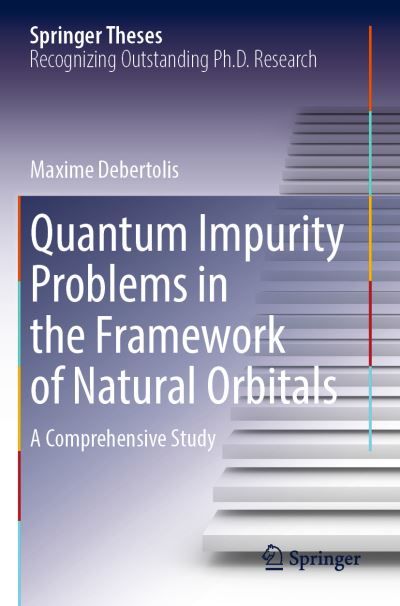
This book presents a complete study of natural orbitals in quantum impurity problems, revealing a certain simplicity in these interacting many-body problems. These systems consist of a few localized degrees of freedom that undergo strong interactions and hybridize with a larger system of free particles; they are central in the study of strongly correlated systems.
In a first step, the standard non-perturbative numerical renormalization group method is employed to demonstrate the hierarchical structure of correlations unveiled by natural orbitals. This simplification brought new insights for simulating quantum impurity problems, and a new algorithm is developed to generate an optimized subset of natural orbitals independently of existing methods, going beyond their usual limitations. This algorithm is presented in detail in the book, and a careful benchmark on known results is carried out to guarantee the validity of the method. It is then used to study spatial entanglement structures under various conditions that were not accessible with previous methods, such as representing the electron bath by a realistic 2D square lattice or taking account of static disorder in the metallic host.
In the last chapter, the non-interacting problem in the presence of disorder is studied through random matrix theory, reproducing some of the results presented in the previous chapters. The main original result of this chapter lies in the analytical calculation of the joint distribution of one-particle orbitals energies and amplitudes of the impurity, which makes it possible to calculate any disordered averaged local correlation functions. Starting from this result, calculations in the large-N limit are compared with numerical simulations.
| ISBN: | 9783031472350 |
| Publication date: | 5th January 2025 |
| Author: | Maxime Debertolis |
| Publisher: | Springer an imprint of Springer Nature Switzerland |
| Format: | Paperback |
| Pagination: | 165 pages |
| Series: | Springer Theses |
| Genres: |
Quantum physics (quantum mechanics and quantum field theory) Engineering applications of electronic, magnetic, optical materials Chemistry |
This book presents a complete study of natural orbitals in quantum impurity problems, revealing a certain simplicity in these interacting many-body problems. These systems consist of a few localized degrees of freedom that undergo strong interactions and hybridize with a larger system of free particles; they are central in the study of strongly correlated systems.
In a first step, the standard non-perturbative numerical renormalization group method is employed to demonstrate the hierarchical structure of correlations unveiled by natural orbitals. This simplification brought new insights for simulating quantum impurity problems, and a new algorithm is developed to generate an optimized subset of natural orbitals independently of existing methods, going beyond their usual limitations. This algorithm is presented in detail in the book, and a careful benchmark on known results is carried out to guarantee the validity of the method. It is then used to study spatial entanglement structures under various conditions that were not accessible with previous methods, such as representing the electron bath by a realistic 2D square lattice or taking account of static disorder in the metallic host.
In the last chapter, the non-interacting problem in the presence of disorder is studied through random matrix theory, reproducing some of the results presented in the previous chapters. The main original result of this chapter lies in the analytical calculation of the joint distribution of one-particle orbitals energies and amplitudes of the impurity, which makes it possible to calculate any disordered averaged local correlation functions. Starting from this result, calculations in the large-N limit are compared with numerical simulations.
Quantum Impurity Problems in the Framework of Natural Orbitals features in the following genres: Quantum physics (quantum mechanics and quantum field theory), Engineering applications of electronic, magnetic, optical materials, Chemistry
Quantum Impurity Problems in the Framework of Natural Orbitals is available in Paperback
Quantum Impurity Problems in the Framework of Natural Orbitals was written by Maxime Debertolis and published by Springer an imprint of Springer Nature Switzerland
Quantum Impurity Problems in the Framework of Natural Orbitals has 165 pages
Yes it is part of Springer Theses series
£107.99