

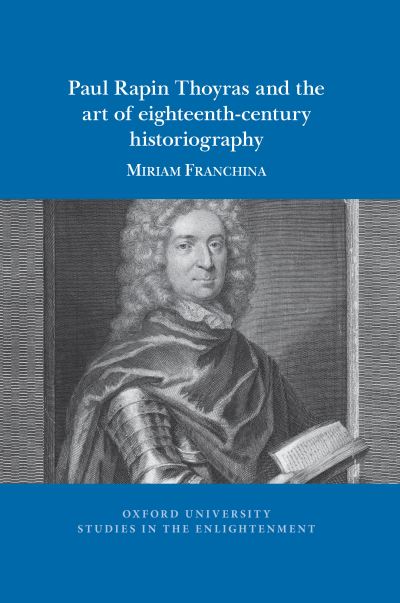
This is the first book on the genesis, impact and reception of the most-widely read History of England of the early 18th century: Paul Rapin Thoyras' Histoire d'Angleterre (1724-27). The Histoire and complementary works (Extraits des Actes de Rymer, 1710-1724; Dissertation sur les Whigs et les Torys, 1717) gave practical expression to theorizations of history against Pyrrhonian postulations by foregrounding an empirical form of history-writing.
Rapin's unprecedented standards of historiographical accuracy triggered both politically-informed reinterpretations of the Histoire in partisan newspapers and a multitude of adaptations that catered to an ever-growing number of readers. Despite a long-standing assessment as a "standard Whig historian", Rapin fashioned the impartial persona of a judge-historian, in compliance with the expectations of the Republic of Letters. His personal trajectory illuminates how scholars pursued trustworthy knowledge and how they reconsidered the boundaries of their community in the face of the booming printing industry and the interconnected growth of general readership. Rapin's oeuvre provided significant raw material for Voltaire's and Hume's Enlightenment historiographical narratives. A comparative foray into their respective different approaches to history and authorship cautions us against assuming a direct transition from the Republic of Letters into an Enlightenment Republic of Letters. To study the diffusion and the impact of Rapin's works is to understand that empirical history-writing, defined by its commitment to erudition in the service of impartiality, coexisted with the histoire philosophique.
| ISBN: | 9781800859890 |
| Publication date: | 13th December 2021 |
| Author: | Miriam Franchina |
| Publisher: | Voltaire Foundation an imprint of Liverpool University Press |
| Format: | Paperback |
| Pagination: | 320 pages |
| Series: | Oxford University Studies in the Enlightenment |
| Genres: |
History of scholarship (principally of social sciences and humanities) Historiography Comparative literature |
This is the first book on the genesis, impact and reception of the most-widely read History of England of the early 18th century: Paul Rapin Thoyras' Histoire d'Angleterre (1724-27). The Histoire and complementary works (Extraits des Actes de Rymer, 1710-1724; Dissertation sur les Whigs et les Torys, 1717) gave practical expression to theorizations of history against Pyrrhonian postulations by foregrounding an empirical form of history-writing.
Rapin's unprecedented standards of historiographical accuracy triggered both politically-informed reinterpretations of the Histoire in partisan newspapers and a multitude of adaptations that catered to an ever-growing number of readers. Despite a long-standing assessment as a "standard Whig historian", Rapin fashioned the impartial persona of a judge-historian, in compliance with the expectations of the Republic of Letters. His personal trajectory illuminates how scholars pursued trustworthy knowledge and how they reconsidered the boundaries of their community in the face of the booming printing industry and the interconnected growth of general readership. Rapin's oeuvre provided significant raw material for Voltaire's and Hume's Enlightenment historiographical narratives. A comparative foray into their respective different approaches to history and authorship cautions us against assuming a direct transition from the Republic of Letters into an Enlightenment Republic of Letters. To study the diffusion and the impact of Rapin's works is to understand that empirical history-writing, defined by its commitment to erudition in the service of impartiality, coexisted with the histoire philosophique.
Paul Rapin Thoyras and the Art of Eighteenth-Century Historiography features in the following genres: History of scholarship (principally of social sciences and humanities), Historiography, Comparative literature
Paul Rapin Thoyras and the Art of Eighteenth-Century Historiography is available in Paperback
Paul Rapin Thoyras and the Art of Eighteenth-Century Historiography was written by Miriam Franchina and published by Voltaire Foundation an imprint of Liverpool University Press
Paul Rapin Thoyras and the Art of Eighteenth-Century Historiography has 320 pages
Yes it is part of Oxford University Studies in the Enlightenment series