

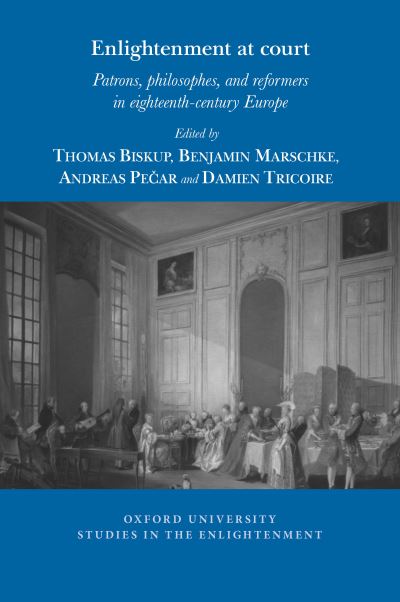
This is the first comprehensive analysis of the royal and princely courts of Europe as important places of Enlightenment. The households of European rulers remained central to politics and culture throughout the eighteenth century, and few writers, artists, musicians, or scholars could succeed without establishing connections to ruling houses, noble families, or powerful courtiers.
Covering case studies from Spain and France to Russia, and from Scandinavia and Britain to the Holy Roman Empire, the contributions of this volume examine how Enlightenment figures were integrated into the princely courts of the Ancien Régime, and what kinds of relationships they had with courtiers. Dangers and opportunities presented by proximity to court are discussed as well as the question of what rulers and courtiers gained from their interactions with Enlightenment men and women of letters. The book focusses on four areas: firstly, the impact of courtly patronage on Enlightenment discourses and the work as well as careers of Enlightenment writers; secondly, the court as an audience to be catered for by Enlightenment writers; thirdly, the function of Enlightenment narratives and discourses for the image-making of rulers and courtiers; and fourthly, the role the interaction of courtiers and Enlightenment writers played for the formulation of reform policies.
| ISBN: | 9781800855076 |
| Publication date: | 8th August 2022 |
| Author: | Thomas Biskup, Benjamin Marschke, Andreas Pecar, Damien Tricoire |
| Publisher: | Voltaire Foundation an imprint of Liverpool University Press |
| Format: | Paperback |
| Pagination: | 299 pages |
| Series: | Oxford University Studies in the Enlightenment |
| Genres: |
Social and cultural history |
This is the first comprehensive analysis of the royal and princely courts of Europe as important places of Enlightenment. The households of European rulers remained central to politics and culture throughout the eighteenth century, and few writers, artists, musicians, or scholars could succeed without establishing connections to ruling houses, noble families, or powerful courtiers.
Covering case studies from Spain and France to Russia, and from Scandinavia and Britain to the Holy Roman Empire, the contributions of this volume examine how Enlightenment figures were integrated into the princely courts of the Ancien Régime, and what kinds of relationships they had with courtiers. Dangers and opportunities presented by proximity to court are discussed as well as the question of what rulers and courtiers gained from their interactions with Enlightenment men and women of letters. The book focusses on four areas: firstly, the impact of courtly patronage on Enlightenment discourses and the work as well as careers of Enlightenment writers; secondly, the court as an audience to be catered for by Enlightenment writers; thirdly, the function of Enlightenment narratives and discourses for the image-making of rulers and courtiers; and fourthly, the role the interaction of courtiers and Enlightenment writers played for the formulation of reform policies.
Enlightenment at Court features in the following genres: Social and cultural history
Enlightenment at Court is available in Paperback
Enlightenment at Court was written by Thomas Biskup, Benjamin Marschke, Andreas Pecar, Damien Tricoire and published by Voltaire Foundation an imprint of Liverpool University Press
Enlightenment at Court has 299 pages
Yes it is part of Oxford University Studies in the Enlightenment series