

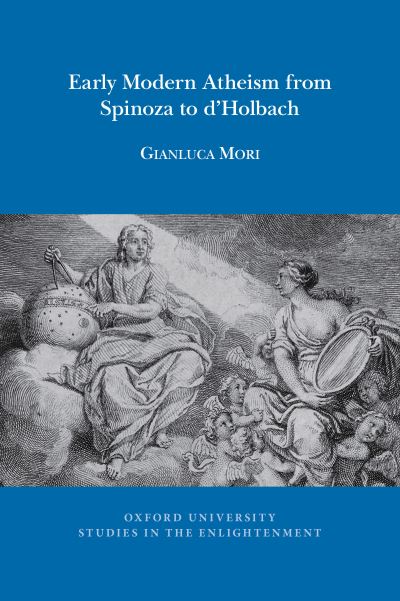
Examining the birth and development of early modern atheism from Spinoza's Tractatus theologico-politicus (1670) to d'Holbach's Système de la nature (1770), this study considers Spinoza, Hobbes, Cudworth, Bayle, Meslier, Boulainviller, Du Marsais, Fréret, Toland, Collins, Hume, Diderot, Voltaire, and d'Holbach and positions them in a general interpretive scheme, based on the idea that early modern atheism is itself an unwanted fruit of early modern metaphysics and theology.
Breaking with a long-standing tradition, Descartes claimed that it was possible to have a "clear and distinct" idea of God, indeed that the idea of God was the "clearest and most distinct" of all ideas accessible to the human mind. Humans could thus obtain a scientific knowledge of God's nature and attributes. But as soon as God became an object of science, He also became the object of a thoroughgoing scientific analysis and criticism.
The effortlessness with which early modern atheists managed to turn round their adversaries' arguments to their own favour is a sign that the new doctrines of God which emerged in the seventeenth-century, each based in its own way on principles and dogmas related to the new science of nature, were plunging headfirst towards the precipice under their own steam.
| ISBN: | 9781800348158 |
| Publication date: | 12th July 2021 |
| Author: | Gianluca Mori |
| Publisher: | Voltaire Foundation an imprint of Liverpool University Press |
| Format: | Paperback |
| Pagination: | 368 pages |
| Series: | Oxford University Studies in the Enlightenment |
| Genres: |
Western philosophy: Enlightenment Agnosticism and atheism |
Examining the birth and development of early modern atheism from Spinoza's Tractatus theologico-politicus (1670) to d'Holbach's Système de la nature (1770), this study considers Spinoza, Hobbes, Cudworth, Bayle, Meslier, Boulainviller, Du Marsais, Fréret, Toland, Collins, Hume, Diderot, Voltaire, and d'Holbach and positions them in a general interpretive scheme, based on the idea that early modern atheism is itself an unwanted fruit of early modern metaphysics and theology.
Breaking with a long-standing tradition, Descartes claimed that it was possible to have a "clear and distinct" idea of God, indeed that the idea of God was the "clearest and most distinct" of all ideas accessible to the human mind. Humans could thus obtain a scientific knowledge of God's nature and attributes. But as soon as God became an object of science, He also became the object of a thoroughgoing scientific analysis and criticism.
The effortlessness with which early modern atheists managed to turn round their adversaries' arguments to their own favour is a sign that the new doctrines of God which emerged in the seventeenth-century, each based in its own way on principles and dogmas related to the new science of nature, were plunging headfirst towards the precipice under their own steam.
Early Modern Atheism from Spinoza to d'Holbach features in the following genres: Western philosophy: Enlightenment, Agnosticism and atheism
Early Modern Atheism from Spinoza to d'Holbach is available in Paperback
Early Modern Atheism from Spinoza to d'Holbach was written by Gianluca Mori and published by Voltaire Foundation an imprint of Liverpool University Press
Early Modern Atheism from Spinoza to d'Holbach has 368 pages
Yes it is part of Oxford University Studies in the Enlightenment series