

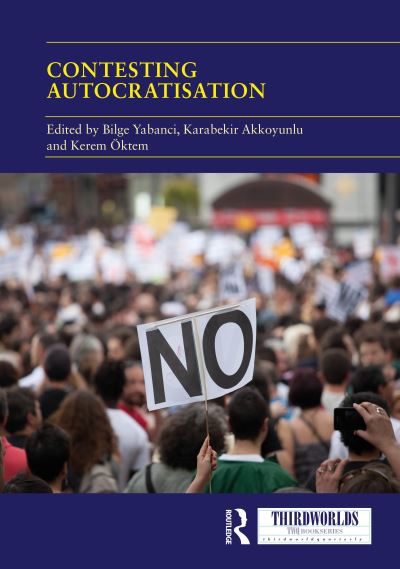
While authoritarianism continues to gain ground globally, this book offers a global and nuanced perspective into how, when, and where autocratisation may be contested and sometimes reversed. Drawing on rich case studies from across Africa, Asia, Latin America, and Southeastern Europe, the chapters in this book map the actors and institutions of resistance, ranging from political parties and bureaucrats to social movements and transnational alliances. Rather than offering a binary view of success or failure of opposition and resistance, this book adopts a dynamic, process-driven approach, considering the conditions under which resistance emerges, adapts, and persists even in shrinking civic and political spaces.
Whether through informal bureaucratic defiance, legal mobilisation, elite rivalries, transnational alliances, strategic litigation, or protest coalitions, these strategies reveal the agency of opposition actors navigating complex and often hostile terrains. These diverse experiences force us to rethink resistance as an ongoing, collective effort rather than a single moment of reversal.
This volume spans multiple disciplines, including political science, sociology, international relations, and legal studies, making it essential reading for students, scholars, and policymakers to understand how resistance emerges, evolves, and endures in the face of authoritarian resurgence.
The chapters in this book were originally published as a special issue of Third World Quarterly.
| ISBN: | 9781041198864 |
| Publication date: | 1st December 2025 |
| Author: | Bilge Yabanci, Karabekir Akkoyunlu, Kerem Öktem |
| Publisher: | Routledge an imprint of Taylor & Francis |
| Format: | Hardback |
| Pagination: | 224 pages |
| Series: | ThirdWorlds |
| Genres: |
Political structures: democracy Social and political philosophy Far-right political ideologies and movements |
While authoritarianism continues to gain ground globally, this book offers a global and nuanced perspective into how, when, and where autocratisation may be contested and sometimes reversed. Drawing on rich case studies from across Africa, Asia, Latin America, and Southeastern Europe, the chapters in this book map the actors and institutions of resistance, ranging from political parties and bureaucrats to social movements and transnational alliances. Rather than offering a binary view of success or failure of opposition and resistance, this book adopts a dynamic, process-driven approach, considering the conditions under which resistance emerges, adapts, and persists even in shrinking civic and political spaces.
Whether through informal bureaucratic defiance, legal mobilisation, elite rivalries, transnational alliances, strategic litigation, or protest coalitions, these strategies reveal the agency of opposition actors navigating complex and often hostile terrains. These diverse experiences force us to rethink resistance as an ongoing, collective effort rather than a single moment of reversal.
This volume spans multiple disciplines, including political science, sociology, international relations, and legal studies, making it essential reading for students, scholars, and policymakers to understand how resistance emerges, evolves, and endures in the face of authoritarian resurgence.
The chapters in this book were originally published as a special issue of Third World Quarterly.
Contesting Autocratisation features in the following genres: Political structures: democracy, Social and political philosophy, Far-right political ideologies and movements
Contesting Autocratisation is available in Hardback
Contesting Autocratisation was written by Bilge Yabanci, Karabekir Akkoyunlu, Kerem Öktem and published by Routledge an imprint of Taylor & Francis
Contesting Autocratisation has 224 pages
Yes it is part of ThirdWorlds series
£154.79