

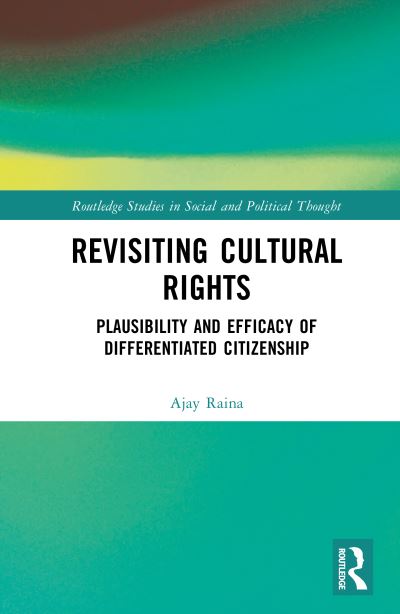
This book reevaluates the 'consensus' liberal view on minority cultural rights from a new, empirically informed perspective to argue that its justificatory machinery is not very persuasive, and that the normative goals of the view can instead be efficaciously reached from within the classic liberal framework of equal, universal rights. The consensus view commonly justifies the special rights of cultural minorities by three arguments: personal autonomy, wellbeing and shared civic identity. The problem with the first is that it sees autonomy as a function purely of 'options', overlooking the role 'preferences' play in choice-making: cultures might provide 'meaningful' options, but they can as well suppress good preferences. Also, while cultural rights over resources and policy might, and often do, improve the wellbeing of Native cultures, economic data show such improvement may not be robust due to institutional limitations. Again, social data convincingly show that cultural rights do not entail shared civic identities; indeed, they might result in isolated communities. This book argues that these ends are better served by improving cross-cultural interaction and exchange, secular formal education, 'capability' formation and policies of 'inductive' civic identity formation. This book is aimed at a broad audience from within and without the academe. Anyone with basic familiarity with liberal thought and interest in public policy issues of multiculturalism and social justice should benefit from it.
| ISBN: | 9781041039716 |
| Publication date: | 26th June 2026 |
| Author: | Ajay Raina |
| Publisher: | Routledge an imprint of Taylor & Francis |
| Format: | Hardback |
| Pagination: | 234 pages |
| Series: | Routledge Studies in Social and Political Thought |
| Genres: |
Social and political philosophy Popular culture Ethnic groups and multicultural studies Centrist democratic ideologies Political structures: democracy Political science and theory |
This book reevaluates the 'consensus' liberal view on minority cultural rights from a new, empirically informed perspective to argue that its justificatory machinery is not very persuasive, and that the normative goals of the view can instead be efficaciously reached from within the classic liberal framework of equal, universal rights. The consensus view commonly justifies the special rights of cultural minorities by three arguments: personal autonomy, wellbeing and shared civic identity. The problem with the first is that it sees autonomy as a function purely of 'options', overlooking the role 'preferences' play in choice-making: cultures might provide 'meaningful' options, but they can as well suppress good preferences. Also, while cultural rights over resources and policy might, and often do, improve the wellbeing of Native cultures, economic data show such improvement may not be robust due to institutional limitations. Again, social data convincingly show that cultural rights do not entail shared civic identities; indeed, they might result in isolated communities. This book argues that these ends are better served by improving cross-cultural interaction and exchange, secular formal education, 'capability' formation and policies of 'inductive' civic identity formation. This book is aimed at a broad audience from within and without the academe. Anyone with basic familiarity with liberal thought and interest in public policy issues of multiculturalism and social justice should benefit from it.
Revisiting Cultural Rights features in the following genres: Social and political philosophy, Popular culture, Ethnic groups and multicultural studies, Centrist democratic ideologies, Political structures: democracy, Political science and theory
Revisiting Cultural Rights is available in Hardback
Revisiting Cultural Rights was written by Ajay Raina and published by Routledge an imprint of Taylor & Francis
Revisiting Cultural Rights has 234 pages
Yes it is part of Routledge Studies in Social and Political Thought series
£154.79