

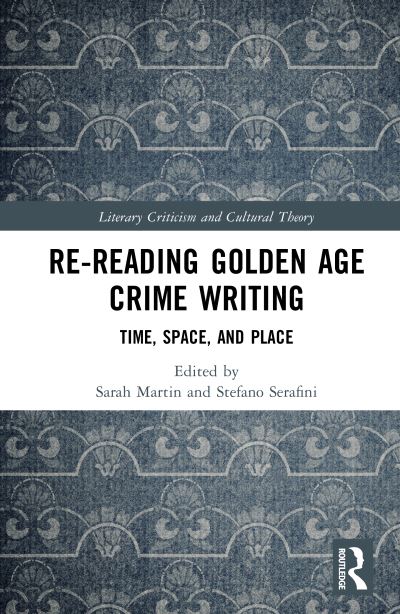
Re-Reading Golden Age Crime Writing: Time, Space, and Place intervenes in debates on crime literature by offering the first sustained analysis of British and American Golden Age fiction, broadly spanning the 1910s to the 1950s, through the interrelated yet analytically distinct frameworks of time, space, and place. It shows how each dimension shapes both the genre and individual texts, and how their interactions generate specific narrative, thematic, and ideological effects. Building on recent scholarship that understands crime fiction as mobile, composite, and open to continual reinterpretation, the volume foregrounds the thematic richness, theoretical sophistication, and experimental energies of Golden Age writing. It proposes a coherent critical framework and flexible set of tools for rethinking the genre. Drawing on paradigms such as Bakhtin's chronotope, islandness, heterotopia, human geography, hauntology, psychogeography, and spatial discourse analysis, the contributors demonstrate how time, space, and place structure narrative possibility, organise perception, and mediate questions of crime, knowledge, justice, and power. Combining diverse theoretical paradigms, the book shows how these dimensions shape narrative possibility and mediate questions of crime, knowledge, justice, and power, reconceptualising the genre's formal and ideological complexity.
| ISBN: | 9781032822648 |
| Publication date: | 2nd September 2026 |
| Author: | Sarah Martin, Stefano Serafini |
| Publisher: | Routledge an imprint of Taylor & Francis |
| Format: | Hardback |
| Pagination: | 204 pages |
| Series: | Literary Criticism and Cultural Theory |
| Genres: |
Literary studies: c 1900 to c 2000 |
Re-Reading Golden Age Crime Writing: Time, Space, and Place intervenes in debates on crime literature by offering the first sustained analysis of British and American Golden Age fiction, broadly spanning the 1910s to the 1950s, through the interrelated yet analytically distinct frameworks of time, space, and place. It shows how each dimension shapes both the genre and individual texts, and how their interactions generate specific narrative, thematic, and ideological effects. Building on recent scholarship that understands crime fiction as mobile, composite, and open to continual reinterpretation, the volume foregrounds the thematic richness, theoretical sophistication, and experimental energies of Golden Age writing. It proposes a coherent critical framework and flexible set of tools for rethinking the genre. Drawing on paradigms such as Bakhtin's chronotope, islandness, heterotopia, human geography, hauntology, psychogeography, and spatial discourse analysis, the contributors demonstrate how time, space, and place structure narrative possibility, organise perception, and mediate questions of crime, knowledge, justice, and power. Combining diverse theoretical paradigms, the book shows how these dimensions shape narrative possibility and mediate questions of crime, knowledge, justice, and power, reconceptualising the genre's formal and ideological complexity.
Re-Reading Golden Age Crime Writing features in the following genres: Literary studies: c 1900 to c 2000
Re-Reading Golden Age Crime Writing is available in Hardback
Re-Reading Golden Age Crime Writing was written by Sarah Martin, Stefano Serafini and published by Routledge an imprint of Taylor & Francis
Re-Reading Golden Age Crime Writing has 204 pages
Yes it is part of Literary Criticism and Cultural Theory series
£139.50