

Every day, in many situations, we use expressions which seem to provide us with only vague information. The weather forecaster tells us that "some showers are likely in Northern regions during the night", a statement which is vague with respect to number of showers, location, and time. Yet such messages are informative, and often it is not possible for the producer of the message to be more precise. A tutor tells his students that "only a few students fail their exams outright". This does not give a precise incidence. Yet it might be equally misleading to do so. For example, to say that twelve percent failed outright last year says nothing about other years, while to say an average of eight percent over the last five years says nothing about variability. We argue that a precise, numerical statement can be sometimes more misleading in reality than a vague statement.
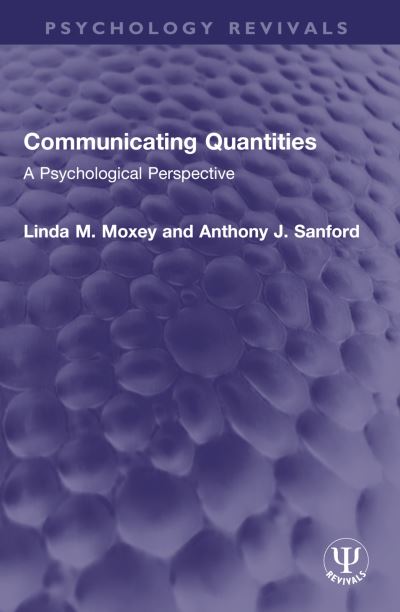
Many researchers in psychology have attempted to capture the meaning of quantities by relating them to scales of quantity. Originally published in 1993, the book explores this idea in detail and shows with original studies how these expressions also serve to control attention and to convey information about the expectations held by those involved in the communication.
The book works towards a psychological theory of the meaning of quantifiers and similarly vague terms. New links are drawn between formal theories of quantification and psychological experimentation.
| ISBN: | 9781032552699 |
| Publication date: | 1st August 2025 |
| Author: | Linda M Moxey, A J Sanford |
| Publisher: | Routledge an imprint of Taylor & Francis |
| Format: | Paperback |
| Pagination: | 144 pages |
| Series: | Psychology Revivals |
| Genres: |
Psycholinguistics and cognitive linguistics Cognition and cognitive psychology |
Every day, in many situations, we use expressions which seem to provide us with only vague information. The weather forecaster tells us that "some showers are likely in Northern regions during the night", a statement which is vague with respect to number of showers, location, and time. Yet such messages are informative, and often it is not possible for the producer of the message to be more precise. A tutor tells his students that "only a few students fail their exams outright". This does not give a precise incidence. Yet it might be equally misleading to do so. For example, to say that twelve percent failed outright last year says nothing about other years, while to say an average of eight percent over the last five years says nothing about variability. We argue that a precise, numerical statement can be sometimes more misleading in reality than a vague statement.
Many researchers in psychology have attempted to capture the meaning of quantities by relating them to scales of quantity. Originally published in 1993, the book explores this idea in detail and shows with original studies how these expressions also serve to control attention and to convey information about the expectations held by those involved in the communication.
The book works towards a psychological theory of the meaning of quantifiers and similarly vague terms. New links are drawn between formal theories of quantification and psychological experimentation.
Communicating Quantities features in the following genres: Psycholinguistics and cognitive linguistics, Cognition and cognitive psychology
Communicating Quantities is available in Paperback
Communicating Quantities was written by Linda M Moxey, A J Sanford and published by Routledge an imprint of Taylor & Francis
Communicating Quantities has 144 pages
Yes it is part of Psychology Revivals series
£26.99