

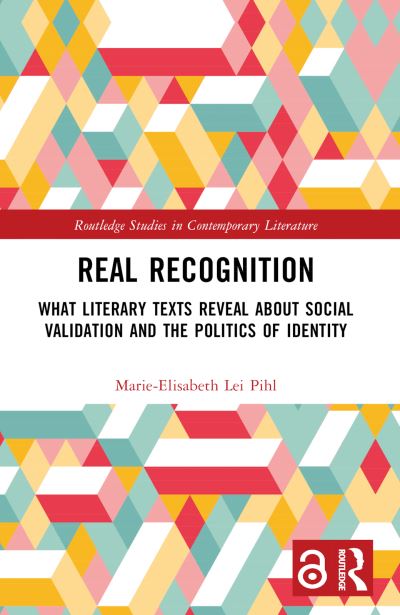
Real Recognition investigates the complexities of literary and social recognition with the aim of putting a fresh, cross-disciplinary spin on reader identification and social acknowledgment. Engaging with contemporary Danish and Anglophone works on racialization, disability, and gender, Marie-Elisabeth Lei Pihl argues in favor of a close relation between aesthetic appeals to recognition and the political dimensions of literary texts. Moreover, she proposes a framework bent on experience and relations, as opposed to identity and status, for articulating new fruitful understandings of how literary texts call for aesthetic and social recognition. Based on this, she argues that literary texts can make readers get what social validation is about - and thereby help us redefine a key concept in the social sciences.
Marie-Elisabeth Lei Pihl earned her PhD in literature and sociology from the University of Southern Denmark in 2020. Currently, she works as a postdoctoral researcher within narrative medicine and literature-based social interventions at the University of Southern Denmark in collaboration with the National Institute of Public Health in Copenhagen.
Chapter 3 of this book is available for free in PDF format as Open Access from the individual product page at www.routledge.com. It has been made available under a Creative Commons Attribution-Non Commercial-No Derivatives 4.0 license.
| ISBN: | 9781032340944 |
| Publication date: | 27th May 2024 |
| Author: | MarieElisabeth Lei Pihl |
| Publisher: | Routledge an imprint of Taylor & Francis |
| Format: | Paperback |
| Pagination: | 216 pages |
| Series: | Routledge Studies in Contemporary Literature |
| Genres: |
Literary studies: c 1900 to c 2000 Sociology Literary theory |
Real Recognition investigates the complexities of literary and social recognition with the aim of putting a fresh, cross-disciplinary spin on reader identification and social acknowledgment. Engaging with contemporary Danish and Anglophone works on racialization, disability, and gender, Marie-Elisabeth Lei Pihl argues in favor of a close relation between aesthetic appeals to recognition and the political dimensions of literary texts. Moreover, she proposes a framework bent on experience and relations, as opposed to identity and status, for articulating new fruitful understandings of how literary texts call for aesthetic and social recognition. Based on this, she argues that literary texts can make readers get what social validation is about - and thereby help us redefine a key concept in the social sciences.
Marie-Elisabeth Lei Pihl earned her PhD in literature and sociology from the University of Southern Denmark in 2020. Currently, she works as a postdoctoral researcher within narrative medicine and literature-based social interventions at the University of Southern Denmark in collaboration with the National Institute of Public Health in Copenhagen.
Chapter 3 of this book is available for free in PDF format as Open Access from the individual product page at www.routledge.com. It has been made available under a Creative Commons Attribution-Non Commercial-No Derivatives 4.0 license.
Real Recognition features in the following genres: Literary studies: c 1900 to c 2000, Sociology, Literary theory
Real Recognition is available in Paperback, Hardback, Ebook
Real Recognition was written by MarieElisabeth Lei Pihl and published by Routledge an imprint of Taylor & Francis
Real Recognition has 216 pages
Yes it is part of Routledge Studies in Contemporary Literature series
£37.79