

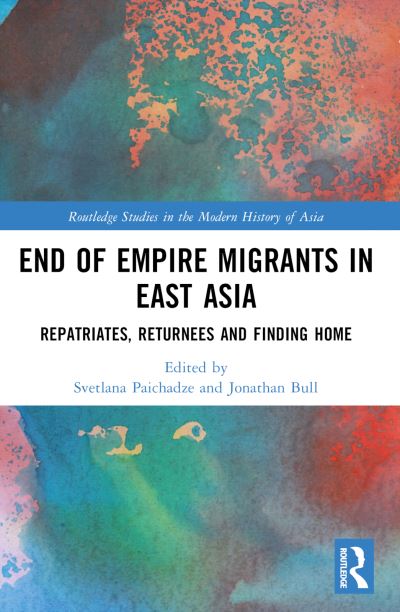
This book provides an interdisciplinary study about the migration of approximately 9 million people who became end of empire migrants in East Asia following the collapse of the Japanese Empire in 1945.
Through the collection of first-hand testimonies and examination of four key themes, the book uncovers how the Japanese government's repatriation policy intersected with people's experiences of end of empire migration in East Asia. The first theme, repatriation as historiography and discourse, examines how repatriation has been studied, debated and represented in Japan since the end of the Second World War. The second theme, finding home in the former empire, reveals the diversity of experiences of the peoples of former colonies as the borders 'shifted under their feet' through first-hand testimony. The third theme, government policy, explores the changing Japanese government policy from the 1950s to the 1970s. The fourth theme, integration after repatriation, reveals how Japanese former colonial residents integrated into Japanese society following repatriation.
Presenting the collective research of 14 international authors, this book will be of interest for researchers of East Asian history, modern Japanese history, migration studies, postcolonial studies, Japanese studies, Korean studies, post-war international relations and Cold War history.
| ISBN: | 9781032284989 |
| Publication date: | 8th October 2024 |
| Author: | Svetlana Paichadze, Jonathan Bull |
| Publisher: | Routledge an imprint of Taylor & Francis |
| Format: | Paperback |
| Pagination: | 272 pages |
| Series: | Routledge Studies in the Modern History of Asia |
| Genres: |
Asian history Ethnic studies Sociology International relations Regional / International studies |
This book provides an interdisciplinary study about the migration of approximately 9 million people who became end of empire migrants in East Asia following the collapse of the Japanese Empire in 1945.
Through the collection of first-hand testimonies and examination of four key themes, the book uncovers how the Japanese government's repatriation policy intersected with people's experiences of end of empire migration in East Asia. The first theme, repatriation as historiography and discourse, examines how repatriation has been studied, debated and represented in Japan since the end of the Second World War. The second theme, finding home in the former empire, reveals the diversity of experiences of the peoples of former colonies as the borders 'shifted under their feet' through first-hand testimony. The third theme, government policy, explores the changing Japanese government policy from the 1950s to the 1970s. The fourth theme, integration after repatriation, reveals how Japanese former colonial residents integrated into Japanese society following repatriation.
Presenting the collective research of 14 international authors, this book will be of interest for researchers of East Asian history, modern Japanese history, migration studies, postcolonial studies, Japanese studies, Korean studies, post-war international relations and Cold War history.
End of Empire Migrants in East Asia features in the following genres: Asian history, Ethnic studies, Sociology, International relations, Regional / International studies
End of Empire Migrants in East Asia is available in Paperback, Hardback
End of Empire Migrants in East Asia was written by Svetlana Paichadze, Jonathan Bull and published by Routledge an imprint of Taylor & Francis
End of Empire Migrants in East Asia has 272 pages
Yes it is part of Routledge Studies in the Modern History of Asia series
£39.59