

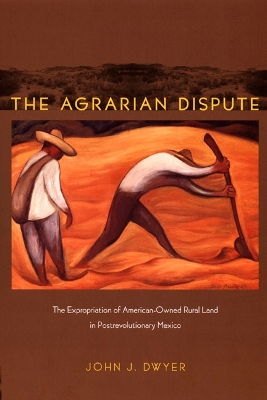
In the mid-1930s the Mexican government expropriated millions of acres of land from hundreds of U.S. property owners as part of President Lázaro Cárdenas’s land redistribution program. Because no compensation was provided to the Americans a serious crisis, which John J. Dwyer terms “the agrarian dispute,” ensued between the two countries. Dwyer’s nuanced analysis of this conflict at the local, regional, national, and international levels combines social, economic, political, and cultural history. He argues that the agrarian dispute inaugurated a new and improved era in bilateral relations because Mexican officials were able to negotiate a favorable settlement, and the United States, constrained economically and politically by the Great Depression, reacted to the crisis with unaccustomed restraint. Dwyer challenges prevailing arguments that Mexico’s nationalization of the oil industry in 1938 was the first test of Franklin Roosevelt’s Good Neighbor policy by showing that the earlier conflict over land was the watershed event.Dwyer weaves together elite and subaltern history and highlights the intricate relationship between domestic and international affairs. Through detailed studies of land redistribution in Baja California and Sonora, he demonstrates that peasant agency influenced the local application of Cárdenas’s agrarian reform program, his regional state-building projects, and his relations with the United States. Dwyer draws on a broad array of official, popular, and corporate sources to illuminate the motives of those who contributed to the agrarian dispute, including landless fieldworkers, indigenous groups, small landowners, multinational corporations, labor leaders, state-level officials, federal policymakers, and diplomats. Taking all of them into account, Dwyer explores the circumstances that spurred agrarista mobilization, the rationale behind Cárdenas’s rural policies, the Roosevelt administration’s reaction to the loss of American-owned land, and the diplomatic tactics employed by Mexican officials to resolve the international conflict.
| ISBN: | 9780822343097 |
| Publication date: | 12th September 2008 |
| Author: | John Dwyer |
| Publisher: | Duke University Press |
| Format: | Paperback |
| Pagination: | 388 pages |
| Series: | American Encounters/Global Interactions |
| Genres: |
History of the Americas |
In the mid-1930s the Mexican government expropriated millions of acres of land from hundreds of U.S. property owners as part of President Lázaro Cárdenas’s land redistribution program. Because no compensation was provided to the Americans a serious crisis, which John J. Dwyer terms “the agrarian dispute,” ensued between the two countries. Dwyer’s nuanced analysis of this conflict at the local, regional, national, and international levels combines social, economic, political, and cultural history. He argues that the agrarian dispute inaugurated a new and improved era in bilateral relations because Mexican officials were able to negotiate a favorable settlement, and the United States, constrained economically and politically by the Great Depression, reacted to the crisis with unaccustomed restraint. Dwyer challenges prevailing arguments that Mexico’s nationalization of the oil industry in 1938 was the first test of Franklin Roosevelt’s Good Neighbor policy by showing that the earlier conflict over land was the watershed event.Dwyer weaves together elite and subaltern history and highlights the intricate relationship between domestic and international affairs. Through detailed studies of land redistribution in Baja California and Sonora, he demonstrates that peasant agency influenced the local application of Cárdenas’s agrarian reform program, his regional state-building projects, and his relations with the United States. Dwyer draws on a broad array of official, popular, and corporate sources to illuminate the motives of those who contributed to the agrarian dispute, including landless fieldworkers, indigenous groups, small landowners, multinational corporations, labor leaders, state-level officials, federal policymakers, and diplomats. Taking all of them into account, Dwyer explores the circumstances that spurred agrarista mobilization, the rationale behind Cárdenas’s rural policies, the Roosevelt administration’s reaction to the loss of American-owned land, and the diplomatic tactics employed by Mexican officials to resolve the international conflict.
The Agrarian Dispute features in the following genres: History of the Americas
The Agrarian Dispute is available in Hardback, Paperback
The Agrarian Dispute was written by John Dwyer and published by Duke University Press
The Agrarian Dispute has 388 pages
Yes it is part of American Encounters/Global Interactions series