

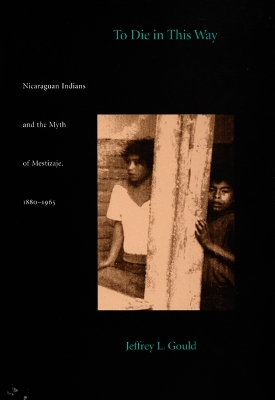
Challenging the widely held belief that Nicaragua has been ethnically homogeneous since the nineteenth century, To Die in This Way reveals the continued existence and importance of an officially “forgotten” indigenous culture. Jeffrey L. Gould argues that mestizaje—a cultural homogeneity that has been hailed as a cornerstone of Nicaraguan national identity—involved a decades-long process of myth building.Through interviews with indigenous peoples and records of the elite discourse that suppressed the expression of cultural differences and rationalized the destruction of Indian communities, Gould tells a story of cultural loss. Land expropriation and coerced labor led to cultural alienation that shamed the indigenous population into shedding their language, religion, and dress. Beginning with the 1870s, Gould historicizes the forces that prompted a collective movement away from a strong identification with indigenous cultural heritage to an “acceptance” of a national mixed-race identity. By recovering a significant part of Nicaraguan history that has been excised from the national memory, To Die in This Way critiques the enterprise of third world nation-building and thus marks an important step in the study of Latin American culture and history that will also interest anthropologists and students of social and cultural historians.
| ISBN: | 9780822320982 |
| Publication date: | 7th July 1998 |
| Author: | Jeffrey L Gould |
| Publisher: | Duke University Press |
| Format: | Paperback |
| Pagination: | 336 pages |
| Series: | Latin America Otherwise |
| Genres: |
History of the Americas Social and cultural history Indigenous peoples Social and cultural anthropology |
Challenging the widely held belief that Nicaragua has been ethnically homogeneous since the nineteenth century, To Die in This Way reveals the continued existence and importance of an officially “forgotten” indigenous culture. Jeffrey L. Gould argues that mestizaje—a cultural homogeneity that has been hailed as a cornerstone of Nicaraguan national identity—involved a decades-long process of myth building.Through interviews with indigenous peoples and records of the elite discourse that suppressed the expression of cultural differences and rationalized the destruction of Indian communities, Gould tells a story of cultural loss. Land expropriation and coerced labor led to cultural alienation that shamed the indigenous population into shedding their language, religion, and dress. Beginning with the 1870s, Gould historicizes the forces that prompted a collective movement away from a strong identification with indigenous cultural heritage to an “acceptance” of a national mixed-race identity. By recovering a significant part of Nicaraguan history that has been excised from the national memory, To Die in This Way critiques the enterprise of third world nation-building and thus marks an important step in the study of Latin American culture and history that will also interest anthropologists and students of social and cultural historians.
To Die in this Way features in the following genres: History of the Americas, Social and cultural history, Indigenous peoples, Social and cultural anthropology
To Die in this Way is available in Hardback, Paperback
To Die in this Way was written by Jeffrey L Gould and published by Duke University Press
To Die in this Way has 336 pages
Yes it is part of Latin America Otherwise series