

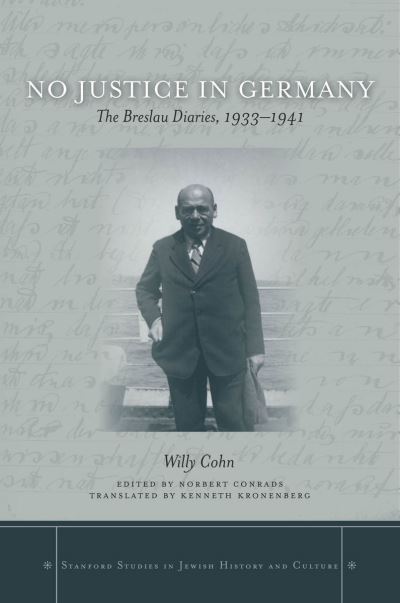
With great immediacy, the diaries of Willy Cohn, a Jew and a Social Democrat, show how the process of marginalization under the Nazis unfolded within the vibrant Jewish community of Breslau-until that community was destroyed in 1941. Cohn documents how difficult it was to understand precisely what was happening, even as people were harassed, beaten, and taken off to concentration camps. He chronicles the efforts of the community to maintain some semblance of normal life at the same time as many made plans to emigrate or to get their children out.
Cohn and his wife Gertrud were able to get their three oldest children out of Germany before it was too late. However, burying himself in his work chronicling the history of the Jews in Germany, his diaries, and his memoirs, Cohn missed his own chance to escape. In late 1941, he, Gertrud, and their two young daughters were deported to Lithuania, where they were shot.
Willy Cohn was a complex individual: an Orthodox Jew and a socialist; an ardent Zionist and a staunch German patriot; a realist but also an idealist often unable to cope with reality; a democrat and an admirer of certain Nazi policies and of their resoluteness. These contradictions and the wealth of detail that poured from his pen give us a unique view of those disorienting and frightening times in Germany.
| ISBN: | 9780804773249 |
| Publication date: | 10th October 2012 |
| Author: | Willy Cohn |
| Publisher: | Stanford University Press |
| Format: | Hardback |
| Pagination: | 440 pages |
| Series: | Stanford Studies in Jewish History and Culture |
| Genres: |
General and world history The Holocaust |
With great immediacy, the diaries of Willy Cohn, a Jew and a Social Democrat, show how the process of marginalization under the Nazis unfolded within the vibrant Jewish community of Breslau-until that community was destroyed in 1941. Cohn documents how difficult it was to understand precisely what was happening, even as people were harassed, beaten, and taken off to concentration camps. He chronicles the efforts of the community to maintain some semblance of normal life at the same time as many made plans to emigrate or to get their children out.
Cohn and his wife Gertrud were able to get their three oldest children out of Germany before it was too late. However, burying himself in his work chronicling the history of the Jews in Germany, his diaries, and his memoirs, Cohn missed his own chance to escape. In late 1941, he, Gertrud, and their two young daughters were deported to Lithuania, where they were shot.
Willy Cohn was a complex individual: an Orthodox Jew and a socialist; an ardent Zionist and a staunch German patriot; a realist but also an idealist often unable to cope with reality; a democrat and an admirer of certain Nazi policies and of their resoluteness. These contradictions and the wealth of detail that poured from his pen give us a unique view of those disorienting and frightening times in Germany.
No Justice in Germany features in the following genres: General and world history, The Holocaust
No Justice in Germany is available in Hardback
No Justice in Germany was written by Willy Cohn and published by Stanford University Press
No Justice in Germany has 440 pages
Yes it is part of Stanford Studies in Jewish History and Culture series