

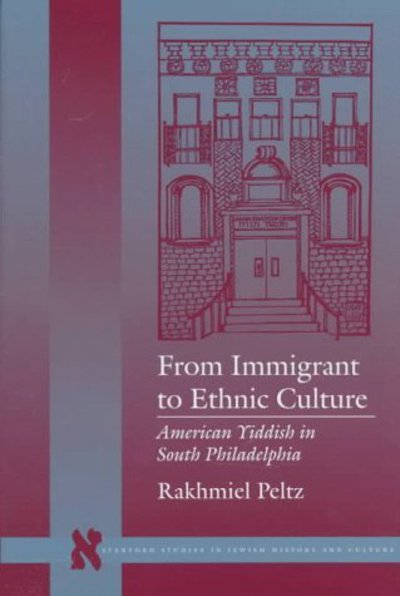
This book provides a fresh look at ethnic culture in the contemporary United States through an ethnographic account of everyday life in the Jewish community of South Philadelphia. By embracing the language and traditions of their childhood, elderly Jewish residents, the children of immigrants, create a path for the transmission of immigrant culture. The work highlights the role of language in collective memory. The residents' use of Yiddish and their warm attitude toward the language illuminate their changing and overlapping identifications with the neighborhood, their non-Jewish neighbors, Jewish traditions and religion, and their children and parents.
The book serves as a corrective to the view of the second generation that concentrates solely on the framework of mobility and rejection of one's parents' culture, neglecting the importance of life cycle changes. It depicts children of immigrants as crucial interpreters of the culture of the immigrants' homeland as they forge a meaningful existence for themselves and their own children. In the course of the work, the author documents and analyzes for the first time the Yiddish speech of American Jews. He examines the cultural implications of the use of English in Yiddish speech, as well as the change in Yiddish sounds and verbal forms.
Throughout, the author carefully examines his own role in revitalizing Yiddish in South Philadelphia as he established close relationships with elderly Jews, meeting them in their homes, shops, and senior center, and leading a Yiddish conversation group at the community center. He thus provides a thoughtful contribution to the methodological discussion among anthropologists, sociologists, and linguists of the paradoxes inherent in participant-observer studies.
| ISBN: | 9780804730204 |
| Publication date: | 1st March 1998 |
| Author: | Rakhmiel Peltz |
| Publisher: | Stanford University Press |
| Format: | Hardback |
| Pagination: | 269 pages |
| Series: | Stanford Studies in Jewish History and Culture |
| Genres: |
Ethnic groups and multicultural studies Society and culture: general |
This book provides a fresh look at ethnic culture in the contemporary United States through an ethnographic account of everyday life in the Jewish community of South Philadelphia. By embracing the language and traditions of their childhood, elderly Jewish residents, the children of immigrants, create a path for the transmission of immigrant culture. The work highlights the role of language in collective memory. The residents' use of Yiddish and their warm attitude toward the language illuminate their changing and overlapping identifications with the neighborhood, their non-Jewish neighbors, Jewish traditions and religion, and their children and parents.
The book serves as a corrective to the view of the second generation that concentrates solely on the framework of mobility and rejection of one's parents' culture, neglecting the importance of life cycle changes. It depicts children of immigrants as crucial interpreters of the culture of the immigrants' homeland as they forge a meaningful existence for themselves and their own children. In the course of the work, the author documents and analyzes for the first time the Yiddish speech of American Jews. He examines the cultural implications of the use of English in Yiddish speech, as well as the change in Yiddish sounds and verbal forms.
Throughout, the author carefully examines his own role in revitalizing Yiddish in South Philadelphia as he established close relationships with elderly Jews, meeting them in their homes, shops, and senior center, and leading a Yiddish conversation group at the community center. He thus provides a thoughtful contribution to the methodological discussion among anthropologists, sociologists, and linguists of the paradoxes inherent in participant-observer studies.
From Immigrant to Ethnic Culture features in the following genres: Ethnic groups and multicultural studies, Society and culture: general
From Immigrant to Ethnic Culture is available in Hardback
From Immigrant to Ethnic Culture was written by Rakhmiel Peltz and published by Stanford University Press
From Immigrant to Ethnic Culture has 269 pages
Yes it is part of Stanford Studies in Jewish History and Culture series