LoveReading Says
LoveReading Says
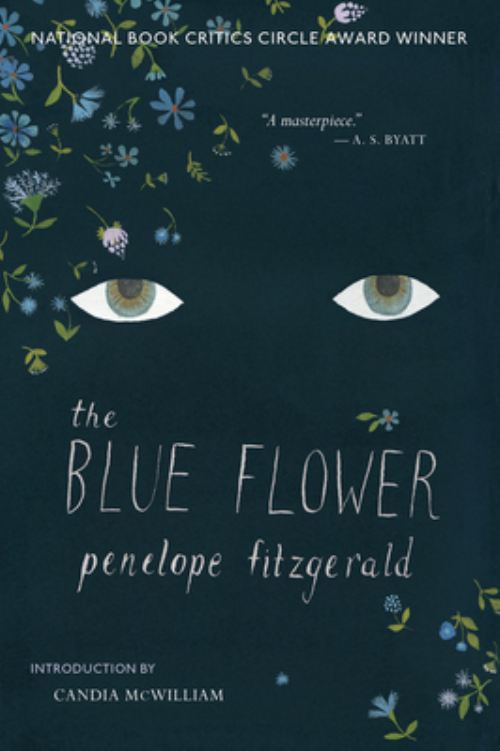
One of the most admired of all Penelope Fitzgerald's books, The Blue Flower was chosen as Book of the Year more than any other in 1995. Her final book, it confirmed her reputation as one of the finest novelists of the century. A masterpiece.
One of Joanna Trollope's favourite books. I had supper with her once, in the converted garage of her daughter’s house, where she was then living, and she was as warm and restrained and acute and beguiling as her books, of which my absolute favourite is The Blue Flower, the story of an extraordinary betrothal in eighteenth century Germany. If anyone needs a pattern of How To Write, Penelope Fitzgerald is IT.
Click here to read Penelope Fitzgerald's son-in-law discuss her legacy to coincide with the 100th anniversary of her birth.
Selected by our Spring 2021 Guest Editor, Guy Gavriel Kay
LoveReading
About The Blue Flower
"An astonishing book . . . Fitzgerald's greatest triumph." -New York Times Book ReviewThe Blue Flower is set in the age of Goethe, in the small towns and great universities of late eighteenth-century Germany. It tells the true story of Friedrich von Hardenberg, a passionate, impetuous student of philosophy who will later gain fame as the Romantic poet Novalis. Fritz seeks his father's permission to wed his "heart's heart," his "spirit's guide"-a plain, simple child named Sophie von Kühn. It is an attachment that shocks his family and friends. Their brilliant young Fritz, betrothed to a twelve-year-old dullard? How can this be?The irrationality of love, the transfiguration of the commonplace, the clarity of purpose that comes with knowing one's own fate-these are the themes of this beguiling novel, themes treated with a mix of wit, grace, and mischievous humor unique to the art of Penelope Fitzgerald."An extraordinary imagining . . . an original masterpiece." -Hermione Lee, Financial Times
Find This Book In
About
The Blue Flower Synopsis
"An astonishing book . . . Fitzgerald's greatest triumph." -New York Times Book Review
The Blue Flower is set in the age of Goethe, in the small towns and great universities of late eighteenth-century Germany. It tells the true story of Friedrich von Hardenberg, a passionate, impetuous student of philosophy who will later gain fame as the Romantic poet Novalis. Fritz seeks his father's permission to wed his "heart's heart," his "spirit's guide"-a plain, simple child named Sophie von Kühn. It is an attachment that shocks his family and friends. Their brilliant young Fritz, betrothed to a twelve-year-old dullard? How can this be?
The irrationality of love, the transfiguration of the commonplace, the clarity of purpose that comes with knowing one's own fate-these are the themes of this beguiling novel, themes treated with a mix of wit, grace, and mischievous humor unique to the art of Penelope Fitzgerald.
"An extraordinary imagining . . . an original masterpiece." -Hermione Lee, Financial Times
About This Edition
| ISBN: |
9780544359451 |
| Publication date: |
14th October 2014 |
| Author: |
Penelope Fitzgerald |
| Publisher: |
Mariner Books an imprint of HMH Books |
| Format: |
Paperback |
| Pagination: |
320 pages |
| Primary Genre |
Historical Fiction
|
| Other Genres: |
|
| Recommendations: |
|
Press Reviews
Penelope Fitzgerald Press Reviews
'An enchanting novel about heart, body and mind. The writing is ellipitical and witty! so that what could be a sad little love story is constantly funny and always absorbing. This novel is a jewel.'
Carmen Callil, Daily Telegraph
'Her sense of time and place is marvellously deft, done in a few words. She knows how they all walked, eased their old joints. She knows the damp smell of decay of the ancient schlosses. In a bare little book she reveals a country and an age as lost as Tolstoy's Russia and which we seem somehow always to have known.'
Jane Gardam, Spectator
'Detail, expertly dabbed in, provides a substantial background for the story of a poet which, it is subtly suggested, is also the story of a remarkable moment in the history of civilisation! It is hard to see how the hopes and defeats of Romanticism, or the relation between inspiration and common life, between genius and mere worthiness, could be more deftly rendered than they are in this remarkable novel.'
Frank Kermode, LRB
'A minor miracle of sympathy and crispness.'
Adam Mars
-Jones, Guardian 'An extraordinary imagining! An original masterpiece.
Hermione Lee, Financial Times
'A novel in which the unsaid speaks: it is a masterpiece.'
Candia McWilliam
'A masterpiece. How does she do it?'
A.S. Byatt
'A magical little book.
Doris Lessing
Fritz von Hardenburg, the young philosopher and poet who later took the name Novalis, has finished his university studies and is preparing to follow his father's profession of salt-mine inspector when he meets his 'true philosophy', his 'heart's heart', a 12-year-old girl of unsuitable (middle-class) family and little perceivable intelligence. His friends and family are thrown into confusion; how could this genius have settled for such a simple, juvenile and unattractive creature? Fitzgerald's re-creation of events is, as usual, masterly. We are immersed headlong in the ethics and atmosphere of late-18th-century Germany by her dexterous, adroit ability to impart information as if by osmosis. Her intellect is astounding, but the reader is never left behind. This book is comic, enlightening and a pleasure to read. (Kirkus UK)
Author
About Penelope Fitzgerald
Penelope Fitzgerald was one of the most elegant and distinctive voices in British fiction. She was the author of nine novels, three of which – The Bookshop, The Beginning of Spring and The Gate of Angels – were shortlisted for the Booker Prize. She won the prize in 1979 for Offshore. Her last novel, The Blue Flower, was the most admired novel of 1995, chosen no fewer than nineteen times in the press as the 'Book of the Year'. It won America's National Book Critics' Circle Award, and this helped introduce her to a wider international readership.
A superb biographer and critic, Penelope Fitzgerald was also the author of lives of the artist Edward Burne-Jones (her first book), the poet Charlotte Mew and The Knox Brothers – a study of her remarkable father Edmund Knox, editor of Punch, and his equally remarkable brothers.
Penelope Fitzgerald did not embark on her literary career until the age of sixty. After graduating from Somerville College, Oxford, she worked at the BBC during the war, edited a literary journal, ran a bookshop and taught at various schools, including a theatrical school; her early novels drew upon many of these experiences.
She died in April 2000, at the age of eighty-three.
Click here to read Penelope Fitzgerald's son-in-law discuss her legacy to coincide with the 100th anniversary of her birth.
Fellow novelist Katharine McMahon on Penelope Fitzgerald...
I was introduced to this author just as I began to be published, and I love her wit, and her quirky approach to plot. The Beginning of Spring is a delicious novel, and it's as if the entire book is pitched towards the very last few lines. This reads like a small, perfectly formed, Russian novel, but amazingly is written by a very English author.
More About Penelope Fitzgerald


.jpg)