

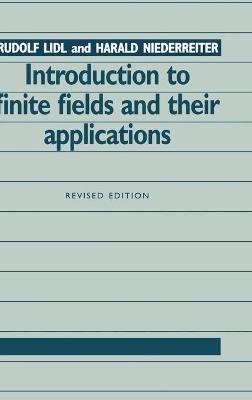
The theory of finite fields is a branch of modern algebra that has come to the fore in recent years because of its diverse applications in such areas as combinatorics, coding theory, cryptology and the mathematical study of switching circuits. The first part of this updated edition presents an introduction to this theory, emphasising those aspects that are relevant for application. The second part is devoted to a discussion of the most important applications of finite fields, especially to information theory, algebraic coding theory and cryptology. There is also a chapter on applications within mathematics, such as finite geometries, combinatorics and pseudo-random sequences. The book is meant to be used as a textbook: worked examples and copious exercises that range from the routine, to those giving alternative proofs of key theorems, to extensions of material covered in the text, are provided throughout. It will appeal to advanced undergraduates and graduate students taking courses on topics in algebra, whether they have backgrounds in mathematics, electrical engineering or computer science. Non-specialists will also find this a readily accessible introduction to an active and increasingly important subject.
| ISBN: | 9780521460941 |
| Publication date: | 21st July 1994 |
| Author: | Rudolf University of Tasmania Lidl, Harald National University of Singapore Niederreiter |
| Publisher: | Cambridge University Press |
| Format: | Hardback |
| Pagination: | 432 pages |
| Genres: |
Algebra |
The theory of finite fields is a branch of modern algebra that has come to the fore in recent years because of its diverse applications in such areas as combinatorics, coding theory, cryptology and the mathematical study of switching circuits. The first part of this updated edition presents an introduction to this theory, emphasising those aspects that are relevant for application. The second part is devoted to a discussion of the most important applications of finite fields, especially to information theory, algebraic coding theory and cryptology. There is also a chapter on applications within mathematics, such as finite geometries, combinatorics and pseudo-random sequences. The book is meant to be used as a textbook: worked examples and copious exercises that range from the routine, to those giving alternative proofs of key theorems, to extensions of material covered in the text, are provided throughout. It will appeal to advanced undergraduates and graduate students taking courses on topics in algebra, whether they have backgrounds in mathematics, electrical engineering or computer science. Non-specialists will also find this a readily accessible introduction to an active and increasingly important subject.
Introduction to Finite Fields and their Applications features in the following genres: Algebra
Introduction to Finite Fields and their Applications is available in Hardback
Introduction to Finite Fields and their Applications was written by Rudolf University of Tasmania Lidl, Harald National University of Singapore Niederreiter and published by Cambridge University Press
Introduction to Finite Fields and their Applications has 432 pages