

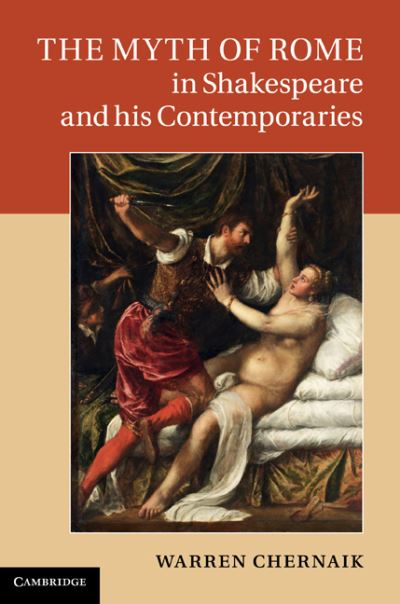
When Cleopatra expresses a desire to die 'after the high Roman fashion', acting in accordance with 'what's brave, what's noble', Shakespeare is suggesting that there are certain values that are characteristically Roman. The use of the terms 'Rome' and 'Roman' in Julius Caesar, Antony and Cleopatra or Jonson's Sejanus often carry the implication that most people fail to live up to this ideal of conduct, that very few Romans are worthy of the name. In this book Chernaik demonstrates how, in these plays, Roman values are held up to critical scrutiny. The plays of Shakespeare, Jonson, Massinger and Chapman often present a much darker image of Rome, as exemplifying barbarism rather than civility. Through a comparative analysis of the Roman plays of Shakespeare and his contemporaries, and including detailed discussion of the classical historians Livy, Tacitus and Plutarch, this study examines the uses of Roman history - 'the myth of Rome' - in Shakespeare's age.
| ISBN: | 9780521196567 |
| Publication date: | 17th March 2011 |
| Author: | Warren L Chernaik |
| Publisher: | Cambridge University Press |
| Format: | Hardback |
| Pagination: | 298 pages |
| Genres: |
Literary studies: general Theatre studies Literary studies: plays and playwrights |
When Cleopatra expresses a desire to die 'after the high Roman fashion', acting in accordance with 'what's brave, what's noble', Shakespeare is suggesting that there are certain values that are characteristically Roman. The use of the terms 'Rome' and 'Roman' in Julius Caesar, Antony and Cleopatra or Jonson's Sejanus often carry the implication that most people fail to live up to this ideal of conduct, that very few Romans are worthy of the name. In this book Chernaik demonstrates how, in these plays, Roman values are held up to critical scrutiny. The plays of Shakespeare, Jonson, Massinger and Chapman often present a much darker image of Rome, as exemplifying barbarism rather than civility. Through a comparative analysis of the Roman plays of Shakespeare and his contemporaries, and including detailed discussion of the classical historians Livy, Tacitus and Plutarch, this study examines the uses of Roman history - 'the myth of Rome' - in Shakespeare's age.
The Myth of Rome in Shakespeare and His Contemporaries features in the following genres: Literary studies: general, Theatre studies, Literary studies: plays and playwrights
The Myth of Rome in Shakespeare and His Contemporaries is available in Hardback
The Myth of Rome in Shakespeare and His Contemporaries was written by Warren L Chernaik and published by Cambridge University Press
The Myth of Rome in Shakespeare and His Contemporaries has 298 pages
£58.50