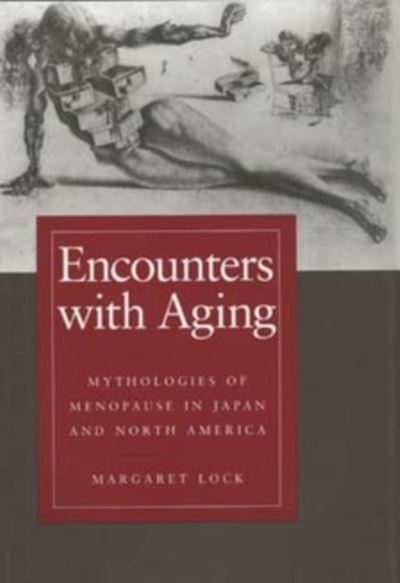
Margaret Lock explicitly compares Japanese and North American medical and political accounts of female middle age to challenge Western assumptions about menopause. She uses ethnography, interviews, statistics, historical and popular culture materials, and medical publications to produce a richly detailed account of Japanese women's lives. The result offers irrefutable evidence that the experience and meanings-even the endocrinological changes-associated with female midlife are far from universal. Rather, Lock argues, they are the product of an ongoing dialectic between culture and local biologies.
Japanese focus on middle-aged women as family members, and particularly as caretakers of elderly relatives. They attach relatively little importance to the end of menstruation, seeing it as a natural part of the aging process and not a diseaselike state heralding physical decline and emotional instability. Even the symptoms of midlife are different: Japanese women report few hot flashes, for example, but complain frequently of stiff shoulders.
Articulate, passionate, and carefully documented, Lock's study systematically undoes the many preconceptions about aging women in two distinct cultural settings. Because it is rooted in the everyday lives of Japanese women, it also provides an excellent entree to Japanese society as a whole.
Aging and menopause are subjects that have been closeted behind our myths, fears, and misconceptions. Margaret Lock's cross-cultural perspective gives us a critical new lens through which to examine our assumptions.
Buy from our bookstore and 25% of the cover price will be given to a school of your choice to buy more books. *15% of eBooks.
Frequently asked questions
Margaret Lock explicitly compares Japanese and North American medical and political accounts of female middle age to challenge Western assumptions about menopause. She uses ethnography, interviews, statistics, historical and popular culture materials, and medical publications to produce a richly detailed account of Japanese women's lives. The result offers irrefutable evidence that the experience and meanings-even the endocrinological changes-associated with female midlife are far from universal. Rather, Lock argues, they are the product of an ongoing dialectic between culture and local biologies.
Japanese focus on middle-aged women as family members, and particularly as caretakers of elderly relatives. They attach relatively little importance to the end of menstruation, seeing it as a natural part of the aging process and not a diseaselike state heralding physical decline and emotional instability. Even the symptoms of midlife are different: Japanese women report few hot flashes, for example, but complain frequently of stiff shoulders.
Articulate, passionate, and carefully documented, Lock's study systematically undoes the many preconceptions about aging women in two distinct cultural settings. Because it is rooted in the everyday lives of Japanese women, it also provides an excellent entree to Japanese society as a whole.
Aging and menopause are subjects that have been closeted behind our myths, fears, and misconceptions. Margaret Lock's cross-cultural perspective gives us a critical new lens through which to examine our assumptions.
Encounters With Aging features in the following genres: Gender studies, gender groups, Anthropology
Encounters With Aging is available in Paperback
Encounters With Aging was written by Margaret M Lock and published by University of California Press
Encounters With Aging has 439 pages
Join Our Community
Join our community for the latest bookish news, reading recommendations, exclusive opening extracts, author events and competitions. It\'s all free. And enter a monthly draw to win a £50 Gift Card. See past winners here