

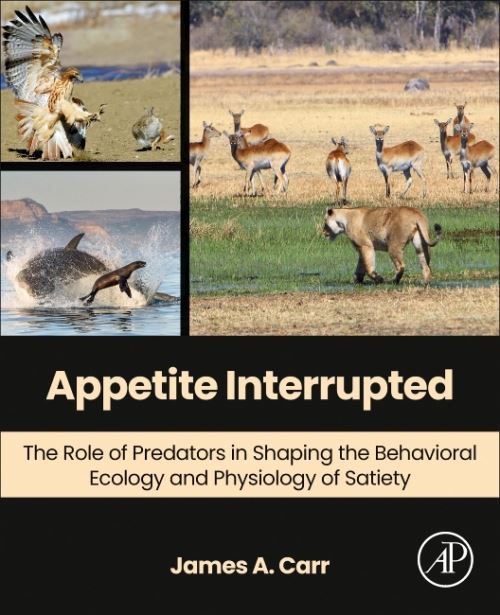
Appetite Interrupted: The Role of Predators in Shaping the Behavioral Ecology and Physiology of Satiety examines the mechanisms that suppress feeding in vertebrate animals within the physiological and ecological contexts that drove their evolution. It emphasizes the role of predation as a selective pressure, noting that the adaptive significance of these inhibitory mechanisms may help identify novel neuroendocrine pathways in future research.
Written by a leading expert in the field, this book systematically explores behavioral ecology, evolutionary pressures, physiological processes, and stressors that impact foraging and feeding behaviors in vertebrates. Early chapters address why animals stop eating, reviewing the selective pressures that drive the evolution of both slow and rapid mechanisms for suppressing hunger and appetite. Central chapters delve into the physiological controls that have evolved to inhibit feeding, including the immense impacts of stress, anxiety, and fear on food intake.
The book concludes with an examination of these pathways in humans and the evolution of obesity. While Appetite Interrupted comparatively approaches the mechanisms controlling food intake, predation, and hunger from an ecological perspective, its coverage of disordered satiety translates to practical and clinical applications of human nutrition. It is therefore an indispensable resource for students, researchers, and industry professionals across broad animal science and healthcare fields.
| ISBN: | 9780443292187 |
| Publication date: | 14th November 2025 |
| Author: | James A Carr |
| Publisher: | Academic Press an imprint of Elsevier Science |
| Format: | Paperback |
| Pagination: | 385 pages |
| Genres: |
Endocrinology Ecological science, the Biosphere Evolution Neurosciences Metabolism Animal husbandry |
Appetite Interrupted: The Role of Predators in Shaping the Behavioral Ecology and Physiology of Satiety examines the mechanisms that suppress feeding in vertebrate animals within the physiological and ecological contexts that drove their evolution. It emphasizes the role of predation as a selective pressure, noting that the adaptive significance of these inhibitory mechanisms may help identify novel neuroendocrine pathways in future research.
Appetite Interrupted features in the following genres: Endocrinology, Ecological science, the Biosphere, Evolution, Neurosciences, Metabolism, Animal husbandry
Paperback. £127.79, down from the £141.99 cover price. Not Available.
Appetite Interrupted was written by James A Carr and published by Academic Press an imprint of Elsevier Science
Appetite Interrupted has 385 pages
£127.79, reduced from £141.99. Not Available.