

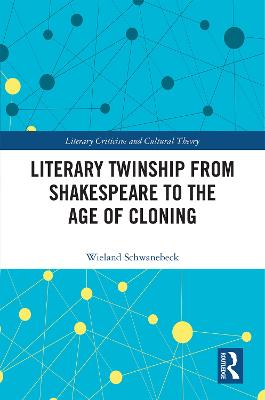
Unlike previous efforts that have only addressed literary twinship as a footnote to the doppelganger motif, this book makes a case for the complexity of literary twinship across the literary spectrum. Shortlisted for the ESSE Book Award 2022 (Literatures in the English Language), it shows how twins have been instrumental to the formation of comedies of mistaken identity, the detective genre, and dystopian science fiction. The individual chapters trace the development of the category of twinship over time, demonstrating how the twin was repeatedly (re-)invented as a cultural and pathological type when other discursive fields constituted themselves, and how its literary treatment served as the battleground for ideological disputes: by setting the stage for debates regarding kinship and reproduction, or by partaking in discussions of criminality, eugenic greatness, and ‘monstrous births’. The book addresses nearly 100 primary texts, including works of Mary Elizabeth Braddon, Wilkie Collins, Charles Dickens, Arthur Conan Doyle, Aldous Huxley, Christopher Priest, William Shakespeare, and Zadie Smith.
| ISBN: | 9780367437893 |
| Publication date: | 14th January 2020 |
| Author: | Wieland Schwanebeck |
| Publisher: | Routledge an imprint of Taylor & Francis Ltd |
| Format: | Hardback |
| Pagination: | 246 pages |
| Series: | Literary Criticism and Cultural Theory |
| Genres: |
Comparative literature European history |
Unlike previous efforts that have only addressed literary twinship as a footnote to the doppelganger motif, this book makes a case for the complexity of literary twinship across the literary spectrum. Shortlisted for the ESSE Book Award 2022 (Literatures in the English Language), it shows how twins have been instrumental to the formation of comedies of mistaken identity, the detective genre, and dystopian science fiction. The individual chapters trace the development of the category of twinship over time, demonstrating how the twin was repeatedly (re-)invented as a cultural and pathological type when other discursive fields constituted themselves, and how its literary treatment served as the battleground for ideological disputes: by setting the stage for debates regarding kinship and reproduction, or by partaking in discussions of criminality, eugenic greatness, and ‘monstrous births’. The book addresses nearly 100 primary texts, including works of Mary Elizabeth Braddon, Wilkie Collins, Charles Dickens, Arthur Conan Doyle, Aldous Huxley, Christopher Priest, William Shakespeare, and Zadie Smith.
Literary Twinship from Shakespeare to the Age of Cloning features in the following genres: Comparative literature, European history
Literary Twinship from Shakespeare to the Age of Cloning is available in Paperback, Hardback, Ebook
Literary Twinship from Shakespeare to the Age of Cloning was written by Wieland Schwanebeck and published by Routledge an imprint of Taylor & Francis Ltd
Literary Twinship from Shakespeare to the Age of Cloning has 246 pages
Yes it is part of Literary Criticism and Cultural Theory series
£117.00