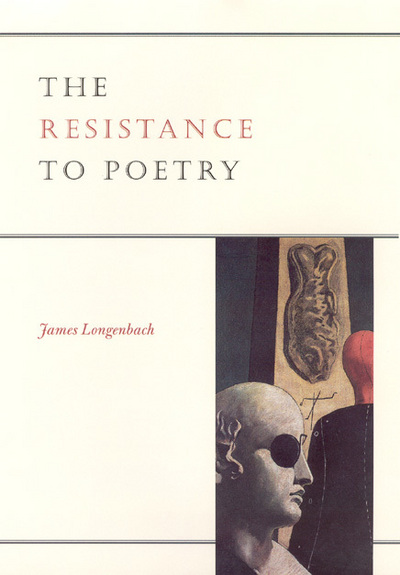
Poems inspire our trust, argues James Longenbach in this bracing work, because they don't necessarily ask to be trusted. Theirs is the language of self-questioning-metaphors that turn against themselves, syntax that moves one way because it threatens to move another. Poems resist themselves more strenuously than they are resisted by the cultures receiving them.
But the resistance to poetry is quite specifically the wonder of poetry. Considering a wide array of poets, from Virgil and Milton to Dickinson and Glück, Longenbach suggests that poems convey knowledge only inasmuch as they refuse to be vehicles for the efficient transmission of knowledge. In fact, this self-resistance is the source of the reader's pleasure: we read poetry not to escape difficulty but to embrace it.
An astute writer and critic of poems, Longenbach makes his case through a sustained engagement with the language of poetry. Each chapter brings a fresh perspective to a crucial aspect of poetry (line, syntax, figurative language, voice, disjunction) and shows that the power of poetry depends less on meaning than on the way in which it means-on the temporal process we negotiate in the act of reading or writing a poem. Readers and writers who embrace that process, Longenbach asserts, inevitably recoil from the exaggeration of the cultural power of poetry in full awareness that to inflate a poem's claim on our attention is to weaken it.
A graceful and skilled study, The Resistance to Poetry honors poetry by allowing it to be what it is. This book arrives at a critical moment-at a time when many people are trying to mold and market poetry into something it is not.
Buy from our bookstore and 25% of the cover price will be given to a school of your choice to buy more books. *15% of eBooks.
Frequently asked questions
Poems inspire our trust, argues James Longenbach in this bracing work, because they don't necessarily ask to be trusted. Theirs is the language of self-questioning-metaphors that turn against themselves, syntax that moves one way because it threatens to move another. Poems resist themselves more strenuously than they are resisted by the cultures receiving them.
But the resistance to poetry is quite specifically the wonder of poetry. Considering a wide array of poets, from Virgil and Milton to Dickinson and Glück, Longenbach suggests that poems convey knowledge only inasmuch as they refuse to be vehicles for the efficient transmission of knowledge. In fact, this self-resistance is the source of the reader's pleasure: we read poetry not to escape difficulty but to embrace it.
An astute writer and critic of poems, Longenbach makes his case through a sustained engagement with the language of poetry. Each chapter brings a fresh perspective to a crucial aspect of poetry (line, syntax, figurative language, voice, disjunction) and shows that the power of poetry depends less on meaning than on the way in which it means-on the temporal process we negotiate in the act of reading or writing a poem. Readers and writers who embrace that process, Longenbach asserts, inevitably recoil from the exaggeration of the cultural power of poetry in full awareness that to inflate a poem's claim on our attention is to weaken it.
A graceful and skilled study, The Resistance to Poetry honors poetry by allowing it to be what it is. This book arrives at a critical moment-at a time when many people are trying to mold and market poetry into something it is not.
The Resistance to Poetry features in the following genres: Literary studies: poetry and poets
The Resistance to Poetry is available in Paperback
The Resistance to Poetry was written by James Longenbach and published by The University of Chicago Press an imprint of University of Chicago Press
The Resistance to Poetry has 144 pages
Join Our Community
Join our community for the latest bookish news, reading recommendations, exclusive opening extracts, author events and competitions. It\'s all free. And enter a monthly draw to win a £50 Gift Card. See past winners here