

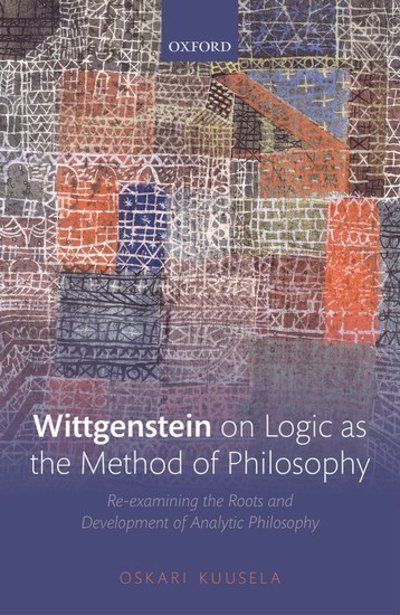
In Wittgenstein on Logic as the Method of Philosophy, Oskari Kuusela examines Wittgenstein's early and late philosophies of logic, situating their philosophical significance in early and middle analytic philosophy with particular reference to Frege, Russell, Carnap, and Strawson. He argues that not only the early but also the later Wittgenstein sought to further develop the logical-philosophical approaches of his contemporaries. Throughout his career Wittgenstein's aim was to resolve problems with and address the limitations of Frege's and Russell's accounts of logic and their logical methodologies so as to achieve the philosophical progress that originally motivated the logical-philosophical approach. By re-examining the roots and development of analytic philosophy, Kuusela seeks to open up covered up paths for the further development of analytic philosophy. Offering a novel interpretation of the philosopher, he explains how Wittgenstein extends logical methodology beyond calculus-based logical methods and how his novel account of the status of logic enables one to do justice to the complexity and richness of language use and thought while retaining rigour and ideals of logic such as simplicity and exactness. In addition, this volume outlines the new kind of non-empiricist naturalism developed in Wittgenstein's later work and explaining how his account of logic can be used to dissolve the long-standing methodological dispute between the ideal and ordinary language schools of analytic philosophy. It is of interest to scholars, researchers, and advance students of philosophy interested in engaging with a number of scholarly debates.
| ISBN: | 9780198829751 |
| Publication date: | 14th January 2019 |
| Author: | Oskari Kuusela |
| Publisher: | Oxford University Press an imprint of OUP OXFORD |
| Format: | Hardback |
| Pagination: | 312 pages |
| Genres: |
Western philosophy from c 1800 Philosophy: logic Philosophy of mind Philosophy of language |
In Wittgenstein on Logic as the Method of Philosophy, Oskari Kuusela examines Wittgenstein's early and late philosophies of logic, situating their philosophical significance in early and middle analytic philosophy with particular reference to Frege, Russell, Carnap, and Strawson. He argues that not only the early but also the later Wittgenstein sought to further develop the logical-philosophical approaches of his contemporaries. Throughout his career Wittgenstein's aim was to resolve problems with and address the limitations of Frege's and Russell's accounts of logic and their logical methodologies so as to achieve the philosophical progress that originally motivated the logical-philosophical approach. By re-examining the roots and development of analytic philosophy, Kuusela seeks to open up covered up paths for the further development of analytic philosophy. Offering a novel interpretation of the philosopher, he explains how Wittgenstein extends logical methodology beyond calculus-based logical methods and how his novel account of the status of logic enables one to do justice to the complexity and richness of language use and thought while retaining rigour and ideals of logic such as simplicity and exactness. In addition, this volume outlines the new kind of non-empiricist naturalism developed in Wittgenstein's later work and explaining how his account of logic can be used to dissolve the long-standing methodological dispute between the ideal and ordinary language schools of analytic philosophy. It is of interest to scholars, researchers, and advance students of philosophy interested in engaging with a number of scholarly debates.
Wittgenstein on Logic as the Method of Philosophy features in the following genres: Western philosophy from c 1800, Philosophy: logic, Philosophy of mind, Philosophy of language
Wittgenstein on Logic as the Method of Philosophy is available in Hardback, Ebook
Wittgenstein on Logic as the Method of Philosophy was written by Oskari Kuusela and published by Oxford University Press an imprint of OUP OXFORD
Wittgenstein on Logic as the Method of Philosophy has 312 pages