

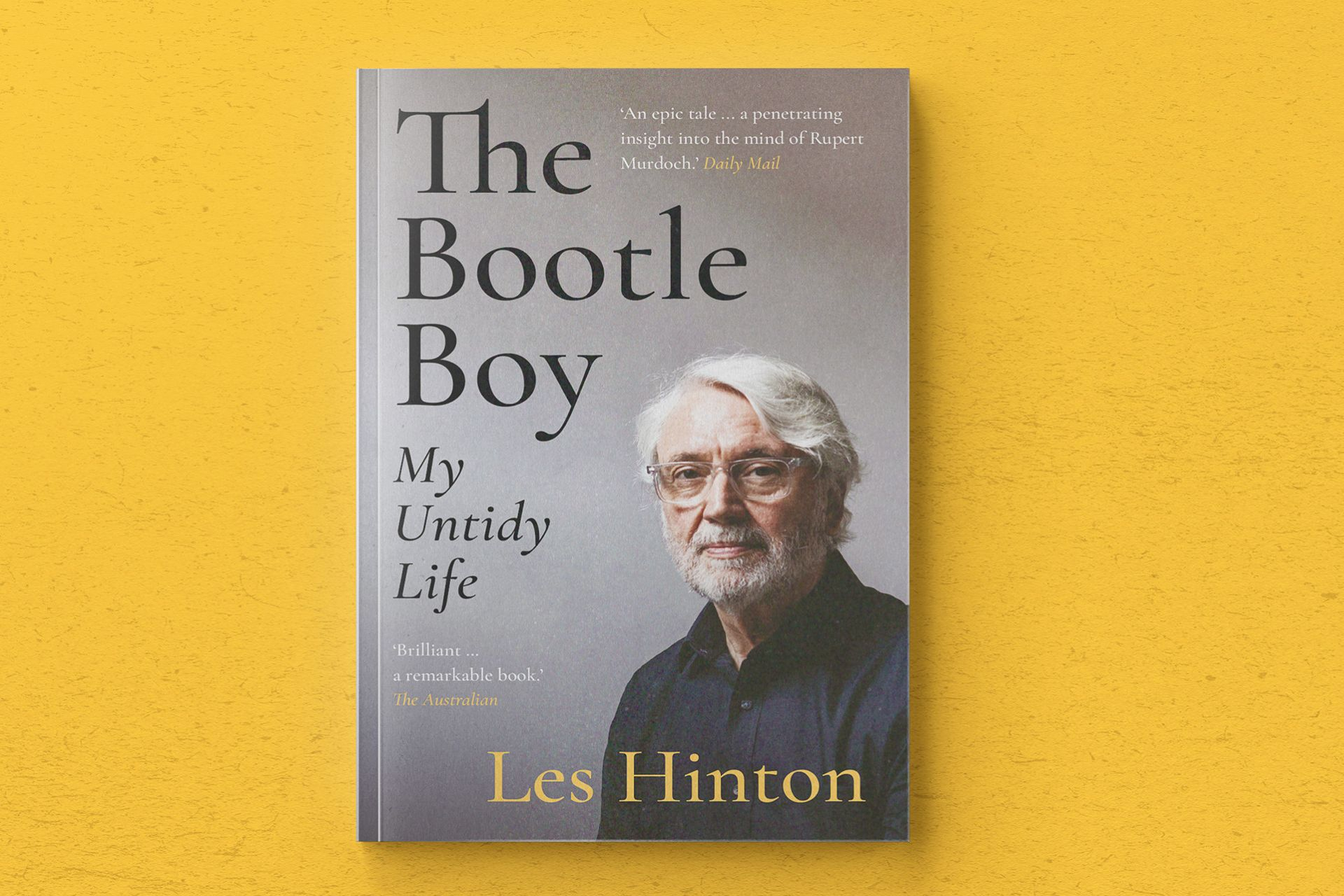
Les Hinton was born in Bootle, Merseyside, England. He is the son of a wandering British Army sergeant and grew up in Egypt, Eritrea, Libya, Germany, Singapore, and Australia. In Adelaide, Australia, he took his first job as a 15-year-old copy boy with an Adelaide newspaper owned by a young Rupert Murdoch. As Murdoch’s empire grew, he worked for him as a reporter, foreign correspondent, editor, and then one of his most senior executives, managing newspapers, magazines, and TV stations.
Bootle Boy is Les Hinton's brilliantly evocative memoir following his remarkable journey and the changes to our media landscape he witnesses over five decades of working with Rupert Murdoch. We appreciated the opportunity to pose some extra questions to Les about his work and the media landscape before us.
Reading Bootle Boy felt incredibly nostalgic for me. Growing up in Crosby, with my dad now living in Bootle, so much of what you describe felt recognisable. How much do you think growing up on Merseyside still shapes the way you see the world today?
Bootle was bomb-damaged and poor in my childhood, but it was my whole world and I knew nothing else. There was no real sense of deprivation because everyone around us lived much the same way. We weren’t constantly bombarded by television programmes and advertising telling us what we didn’t have.
When my Army-cook father took my mum, my brother, my sister and me around the world—to Egypt, Eritrea, Singapore and elsewhere—I began to see how different life could be. Only then did I realise how unlike those places Bootle was, with its outdoor toilet, one cold-water tap, the fog and the cold. Yet Bootle was always where I belonged. We returned regularly until I was fifteen, and every time we came home I felt a sense of comfort and happiness that never left me.
Liverpool has always felt like a city of storytellers. Why do you think Merseyside has produced so many great journalists, writers and communicators?
That’s a difficult one. Liverpool has always been a bustling port city where people, ideas and cultures have constantly rubbed against one another. It has known hardship, prosperity and enormous change. I never thought of it as a relaxed place; it always seemed restless and forever arguing with itself. Maybe that’s what has produced so many people with something to say.
One of the things that struck me is that, despite the extraordinary people you went on to meet and the positions you held, you never seem to lose sight of where you came from. Was that a conscious decision?
It wasn’t so much a conscious decision as an unavoidable state of mind. Bootle is where I came from. It was filled with people who loved me and made me feel loved. Sometimes I think how lucky I was to have led a life that might never have happened if we’d stayed there. At other times I remember the toughness and perseverance my family needed simply to get by, and I’m grateful to have inherited some of those qualities.
You've had a front-row seat to some of the biggest stories of the last fifty years. Looking back, are there moments that still leave you thinking, 'I can't quite believe I was there'?
I still have that feeling all the time. I’ve met presidents and prime ministers, billionaires and film stars. The moment that still makes me smile was visiting 10 Downing Street and having John Major take me by the elbow across a crowded room to introduce me to Bill Clinton. Other memories stay with me for very different reasons: witnessing terrible poverty, seeing the piled bodies of women and children massacred in Cyprus, the horrifying aftermath of air crashes, and the naked hatred in Northern Ireland during the Troubles.
Journalism has changed beyond recognition since you first stepped into a newsroom. What do you think we've lost, what have we gained, and what qualities will always define great journalism?
The best journalism is as good as ever, if not better — the amount of it, the podcasts and online news sites good enough to challenge the mightiest print titles. The terrible change is the avalanche of unedited information pouring into people’s heads every day. It’s making it hard, bordering on impossible for some people, to know what they can believe. It’s one of the biggest challenges of the civilized world.
Bootle Boy is about much more than newspapers. It's about ambition, family, resilience and grabbing opportunities. Was there one defining moment that changed the course of your life, or was it a series of smaller decisions that only make sense in hindsight?
There wasn’t one defining moment. It was a mixture of good fortune, timing and, I hope, some ability. Landing in Adelaide at the age of fifteen, somehow persuading one of Australia’s best editors to give me a job as a copy boy, and doing so at the only newspaper then owned by a young Rupert Murdoch. All that changed the course of my life. Later I was fortunate enough to be sent to New York just as Rupert’s ambitions in America were taking shape. I had to be good enough to earn the opportunities in America, but I was also lucky to arrive at exactly the moment he was looking for people he trusted to help build something much bigger.
As CEO of LoveReading, I'm passionate about the power of stories to change lives. Looking back, what role did reading play in your own childhood? Was there a book, writer or newspaper that first made you curious about the wider world?
First, I had very little formal education. I’d attended schools in several countries without anything like a coordinated syllabus and left a Merseyside secondary modern school just after my fifteenth birthday with no qualifications that entitled me to work in a newsroom. But I had always loved reading from a very early age. I devoured Enid Blyton, Richard Crompton, then Charles Dickens and the newspapers that came into our house—the Daily Mirror, the Daily Mail and the News of the World. Nothing so grand as The Times or The Daily Telegraph. Once I got my copy-boy job on Rupert Murdoch’s newspaper, I realised how much catching up I had to do. I buried myself in books, subscribed to Time and Newsweek, and read biographies of Hearst, Pulitzer, Beaverbrook and Northcliffe—all the great media moguls that Rupert, unknown to anyone, would eventually overshadow. I read a lot of history too.
Writing a memoir means revisiting versions of yourself from decades ago. Were there moments where you found yourself looking at that young Bootle lad differently with the benefit of hindsight?
I often ask my younger self, “How the hell did we do that?” Looking back, I guess youth gives you confidence you don’t even recognise at the time. You just say yes to the next challenge and keep moving. I never stopped to think too much about the risks.
For readers who only know Fleet Street through films and books, what did it actually feel like to walk into those newsrooms at the height of British newspaper journalism?
Learning the trade in Adelaide, Fleet Street was the distant, beckoning Mecca. There was nowhere else in the world I wanted to work. Millions upon millions of newspapers were sold every day. Television news occupied only a few minutes each evening. Print ruled. Fleet Street was the throbbing heart of it all. Every day it transformed blank sheets of paper into the brilliance, drama, trivia, scandal and occasional nonsense of Britain’s national newspapers. It wasn’t easy getting a foothold, though. I papered the lavatory wall of my bedsit with letters of rejection from all the big papers before I got hired as a holiday relief on The Sun before Rupert acquired it.
You witnessed the industry's transition from hot metal to the digital age. Which innovation had the greatest impact on journalism, and which change do you think newspapers have paid the highest price for?
Technology has transformed journalism several times. The high-speed printing press created the mass circulation newspapers. Computers and cold type and colour printing made newspapers faster, better and more efficient. Then the internet and social media revolutionised communication, and wrecked the age-old economics of the newspaper business. Today a device that fits in the palm of your hand provides an endless supply of news, opinion and entertainment. Many newspapers have disappeared, but journalism hasn’t. It is adapting, as it always has and always will. The trade of journalism is indestructible. It will keep evolving.
Your career took you from Bootle to Fleet Street and eventually to New York. Having worked at the highest levels on both sides of the Atlantic, what differences did you notice between British and American journalism, and what did each culture do particularly well?
I first went to America in 1976 as a correspondent. Britain was in an economic crisis and New York City was virtually bankrupt and caught in probably the biggest crime wave of its history. It seemed like jumping from the frying pan into the fire. But American life transformed my outlook on life — for all its imperfections, so irrepressible, so full of untidy ambition and self-belief. There was such a feeling of possibility about it and it was infectious. Britain wasn’t the same, at least not then. It has changed a lot here since. I dreamed when I was young of being able to live at will in New York and London and now I do. At heart the journalism is the same. Americans are inclined to take themselves a little too seriously. Some of the Brit titles have been a little too wild at times.
You worked closely with Rupert Murdoch for many years. What do you think people who have never worked with him misunderstand most about him as a leader?
There are many shades to Murdoch that most people don’t see. He could be hands-off or autocratic, charming or irascible, forgiving or fierce, and sometimes just a comprehensive pain. He could be very tough and surprisingly kind. But he also imbued his companies with a fantastic sense of possibility and got big results. He has many admirers and at least as many critics — he’s definitely a polarizing figure. But it’s undeniable he has become an authentic colossus and I’m sure history will be kinder to him than his harshest detractors.
In an age of AI, misinformation and social media, what worries you most about the future of journalism - and what still gives you hope?
The world is swirling with lies through social media, but good journalism and the demand for it will always change to meet the times. AI will confront us all with pitfalls, but I believe the world will be better for it.
Every journalist has one story they wish they'd covered differently and one story they're quietly most proud of. Looking back across your career, which are yours?
It’s the same story for both questions. I spent a lot of time in Northern Ireland during the worst of The Troubles in the early 1970s. It was terrifying and exhilarating and the biggest story of my life. At the same time, I never felt I got under the skin of the place.
Throughout your career you've had extraordinary access to people in positions of influence and power. Yet reading Bootle Boy, I was left thinking this isn't really a book about power at all - it's a book about people. Was that always the story you wanted to tell?
I just wanted to write from my point of view, from childhood to old age, about the ups and down and periodic miseries People are more the same than they are different. I have seen overweening pride, fear and insecurity, joy and grief in the eyes of the rich and powerful, just the same as everyone else.


Comments (0)
Leave A Reply
You must be logged in to post a comment.