LoveReading Says
One of Hardeep Singh Kohli's favourite books.
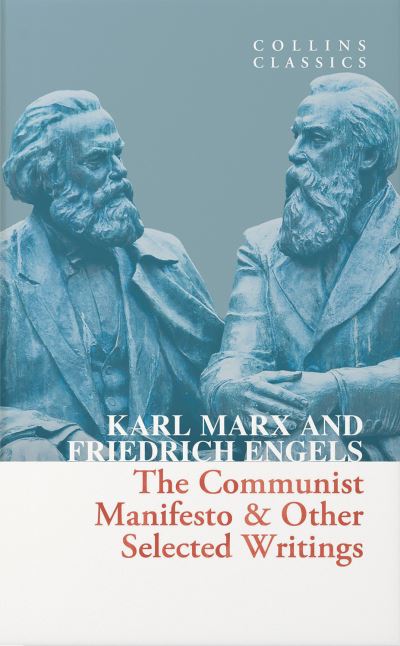
The Communist Manifesto (1848), Marx and Engels's revolutionary
summons to the working classes, is one of the most important and
influential political theories ever formulated.
LoveReading
Find This Book In
| Primary Genre |
History
|
| Recommendations: |
|
About Karl Marx, Friedrich Engels
Karl Marx was born at Trier in 1818 of a German-Jewish family converted to Christianity. As a student in Bonn and Berlin he was influenced by Hegel's dialectic, but he later reacted against idealist philosophy and began to develop his theory of historical materialism. He related the state of society to its economic foundations and mode of production, and recommended armed revolution on the part of the proletariat. In Paris in 1844 Marx met Friedrich Engels, with whom he formed a life-long partnership. Together, they prepared the Manifesto of the Communist Party (1848) as a statement of the Communist League's policy.
In 1848 Marx returned to Germany and took an active part in the unsuccessful democratic revolution. The following year he arrived in England as a refugee and lived in London until his death in 1883. Helped financially by Engels, Marx and his family nevertheless lived in great poverty. After years of research (mostly carried out in the British Museum), he published in 1867 the first volume of his great work, Capital. From 1864 to 1872 Marx played a leading role in the International Working Men's Association, and his last years saw the development of the first mass workers' parties founded on avowedly Marxist principles.
Born in Westphalia in 1820, Friedrich Engels was the son of a textile manufacturer. After military training in Berlin and already a convert to communism, Engels went to Manchester in 1842 to represent the family firm. A relationship with a mill-hand, Mary Bums, and friendship with local Owenites and Chartists helped to inspire his famous early work, The Condition of the Working Class in England in 1844.
Collaboration with Marx began in 1844 and in 1847 he composed the first drafts of the Manifesto. After playing an active part in the German revolutions, Engels returned to work in Manchester until 1870, when he moved to London. He not only helped Marx financially, but reinforced their shared position through his own expositions of the new theory. After Marx’s death, he prepared the unfinished volumes of Capital for publication. He died in London in 1895.
More About Karl Marx, Friedrich Engels