

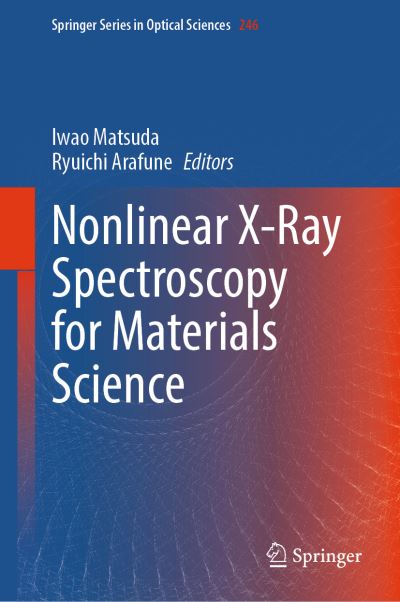
X-ray experiments have been used widely in materials science, and conventional spectroscopy has been based on linear responses in light-matter interactions. Recent development of ultrafast light sources of tabletop lasers and X-ray free electron lasers reveals nonlinear optical phenomena in the X-ray region, and the measurement signals have been found to carry a further wealth of information on materials. This book overviews such nonlinear X-ray spectroscopy and its related issues for materials science. Each chapter is written by pioneers in the field and skillfully reviews the topics of nonlinear spectroscopy including X-ray multi-photon absorption and X-ray second harmonic generation. The chapters are divided depending on photon wavelength, ranging from extreme ultraviolet to (soft) X-ray. To facilitate readers' comprehensive understanding, some of the chapters cover the conventional linear X-ray spectroscopy and basic principles of the non-linear responses. The book is mainly accessible as a primer for junior/senior- or graduate-level readers, and it also serves as a useful reference or guide even for established researchers in optical spectroscopy. The book offers readers opportunities to benefit from cutting-edge research in this new area of nonlinear X-ray spectroscopy.
| ISBN: | 9789819967131 |
| Publication date: | 16th November 2023 |
| Author: | Iwao Matsuda, Ryuichi Arafune |
| Publisher: | Springer an imprint of Springer Nature Singapore |
| Format: | Hardback |
| Pagination: | 160 pages |
| Series: | Springer Series in Optical Sciences |
| Genres: |
Spectrum analysis, spectrochemistry, mass spectrometry Testing of materials Laser physics Optical physics |
X-ray experiments have been used widely in materials science, and conventional spectroscopy has been based on linear responses in light-matter interactions. Recent development of ultrafast light sources of tabletop lasers and X-ray free electron lasers reveals nonlinear optical phenomena in the X-ray region, and the measurement signals have been found to carry a further wealth of information on materials.
Nonlinear X-Ray Spectroscopy for Materials Science features in the following genres: Spectrum analysis, spectrochemistry, mass spectrometry, Testing of materials, Laser physics, Optical physics
Hardback. £107.99, down from the £119.99 cover price. Not Available.
Nonlinear X-Ray Spectroscopy for Materials Science was written by Iwao Matsuda, Ryuichi Arafune and published by Springer an imprint of Springer Nature Singapore
Nonlinear X-Ray Spectroscopy for Materials Science has 160 pages
Yes it is part of Springer Series in Optical Sciences series
£107.99, reduced from £119.99. Not Available.