

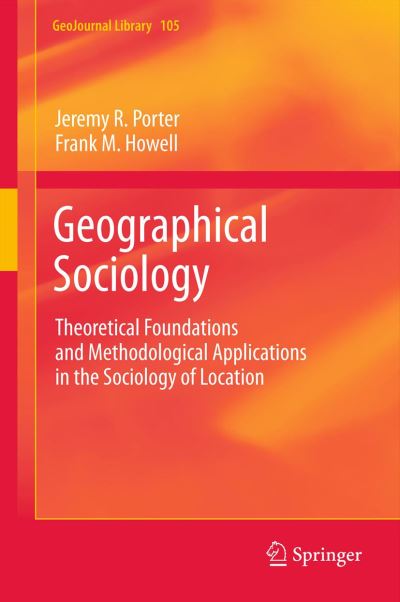
The discipline of Sociology has a rich history of including spatial context in the analysis of social issues. Much of this history has revolved around the development and application of spatial theory aimed at understanding the geographic distribution of social problems, the organization of communities, and the relationship between society and the environment. More recently, the social sciences have seen a large number of technological innovations that now make it possible to place social behaviour in spatial context. Consequently, because of the historical disjuncture in the development of spatial theory and the recent development of relevant methodological tools, the relationship between materials describing both the methodological approaches and their theoretical importance a scattered throughout various books and articles. Geographical Sociology consolidates these materials into a single accessible source in which spatial concepts such as containment, proximity, adjacency, and others are examined in relation to such methodological tools as hierarchical linear models, point pattern analysis, and spatial regression. As these methods continue to increase in popularity among social scientists the ability to more generally understand societies relationship to geographic space will continue to increase in it importance in the field. This book represents a starting point to linking these concepts to practice and is presented in an accessible form in which students, researchers, and educators can all learn, and in turn, contribute to its development.
| ISBN: | 9789400738485 |
| Publication date: | 29th February 2012 |
| Author: | Jeremy Reed Porter, Frank M Howell |
| Publisher: | Springer an imprint of Springer Netherlands |
| Format: | Hardback |
| Pagination: | 126 pages |
| Series: | GeoJournal Library |
| Genres: |
Human geography Regional / International studies Sociology Political economy Geography |
The discipline of Sociology has a rich history of including spatial context in the analysis of social issues. Much of this history has revolved around the development and application of spatial theory aimed at understanding the geographic distribution of social problems, the organization of communities, and the relationship between society and the environment. More recently, the social sciences have seen a large number of technological innovations that now make it possible to place social behaviour in spatial context. Consequently, because of the historical disjuncture in the development of spatial theory and the recent development of relevant methodological tools, the relationship between materials describing both the methodological approaches and their theoretical importance a scattered throughout various books and articles. Geographical Sociology consolidates these materials into a single accessible source in which spatial concepts such as containment, proximity, adjacency, and others are examined in relation to such methodological tools as hierarchical linear models, point pattern analysis, and spatial regression. As these methods continue to increase in popularity among social scientists the ability to more generally understand societies relationship to geographic space will continue to increase in it importance in the field. This book represents a starting point to linking these concepts to practice and is presented in an accessible form in which students, researchers, and educators can all learn, and in turn, contribute to its development.
Geographical Sociology features in the following genres: Human geography, Regional / International studies, Sociology, Political economy, Geography
Hardback. Not Available.
Geographical Sociology was written by Jeremy Reed Porter, Frank M Howell and published by Springer an imprint of Springer Netherlands
Geographical Sociology has 126 pages
Yes it is part of GeoJournal Library series